Tips for Caption Contest 127
There are rules for the exit row. You must be willing and able to assist in the event of an emergency.
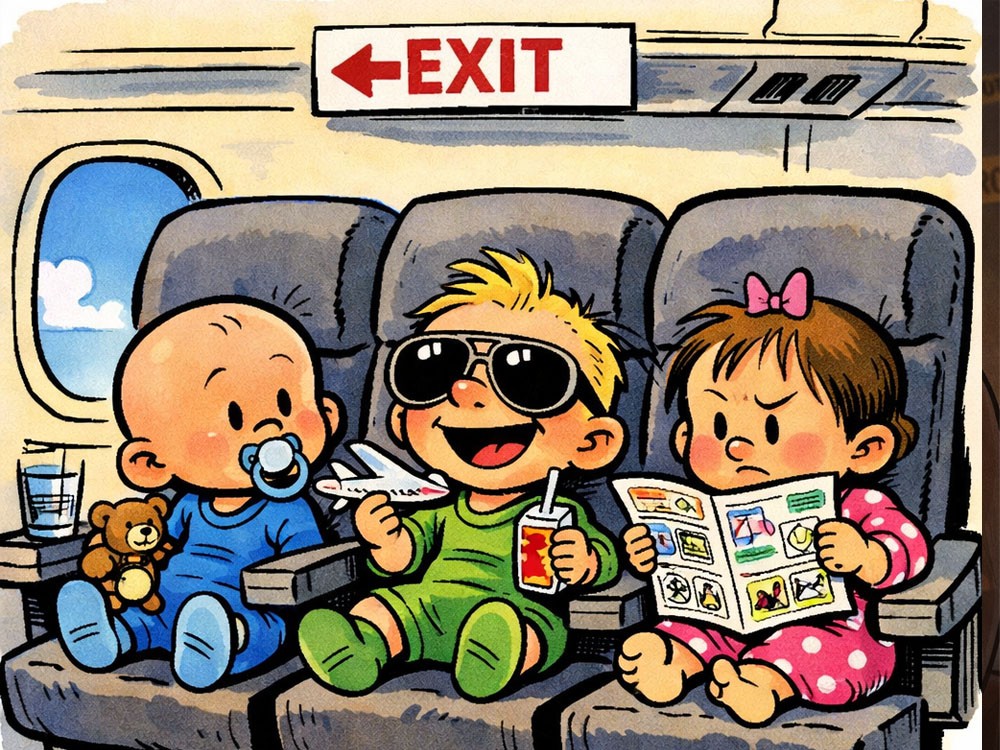
And yet, here we are. Three babies. Zero neck control. Unlimited liability.
This is the kind of image that feels wrong in a very specific way. Not chaotic, not absurd in a loud sense—just quietly, structurally incorrect. The system failed. Or worse, the system approved this.
Your job is to figure out why.
Getting Started: What’s in the Image?
Start with the literal.
You have three babies seated in the exit row of an airplane. That alone does most of the work.
But don’t stop at the headline—zoom in on the details:
-
The setting: a commercial airplane cabin, likely mid-flight or pre-takeoff
-
The location: the exit row, which comes with responsibility and rules
-
The subjects: babies—small, dependent, and famously unqualified for… anything logistical
-
The contrast: high-stakes safety role vs. zero capability
There’s also implied context doing heavy lifting:
-
Flight attendants gave instructions
-
There was some form of approval process
-
Other passengers are (presumably) fine with this
Each of these is a handle you can grab onto.
The strongest captions tend to anchor in one clear observation, not all of them at once.
Think Beneath the Surface
The joke isn’t just “babies in the wrong seats.” That’s the setup. The humor comes from how you interpret the mismatch.
A few productive angles to explore:
Authority vs. incompetence
These babies have been given responsibility they cannot possibly fulfill. That gap is rich. Are they overconfident? Are adults delusional? Is this a staffing issue?
Systems breaking down
Air travel is rigid—rules, announcements, procedures. So how did this happen? Is the airline cutting corners? Is this a loophole? A pilot program gone wrong?
Adult logic applied to baby behavior
Treat the babies like rational actors. Give them motivations, attitudes, or workplace energy. This often sharpens the joke by making the situation feel even more “official.”
Example: “We’ll figure it out when it’s time.”
Underreaction vs. overreaction
You can play this two ways:
-
Underplay the absurdity (everyone acts like this is normal)
-
Overplay the stakes (these babies are the last line of defense)
Both work—just pick one lane and commit.
Language mismatch
Exit row instructions are formal and serious. Babies are not. Putting adult phrasing into this context can create clean contrast.
General Tips on How to Be Funny
Pick one idea and push it
If your caption tries to cover “babies + airplanes + safety + parenting + society,” it’ll dilute. Choose one angle and make it sharp.
Let the image do most of the work
You don’t need to explain that they’re babies or that it’s an exit row. We see it. Use your caption to add meaning, not repeat facts.
Clarity beats cleverness
If the reader has to decode your joke, it’s already losing altitude. Aim for instant recognition.
Use specificity when it helps
Generic jokes feel interchangeable. A precise word or framing can make the idea feel original without making it complicated.
Example: “They all selected ‘Yes’ to assist.”
Commit to the tone
If you start grounded, stay grounded. If you go absurd, go all the way. Half-committed jokes feel like safety demonstrations no one listens to.
Trim aggressively
Most captions improve when you remove the last few words. Get in, land the idea, get out.
Final Thought
This image works because it quietly violates a rule we all understand. Your job isn’t to shout that violation—it’s to frame it in a way that feels both inevitable and ridiculous at the same time.
Now buckle up and give it your best shot ✈️
Enter the contest and show us your sharpest take.