Caption Contest 157: Recap & Review
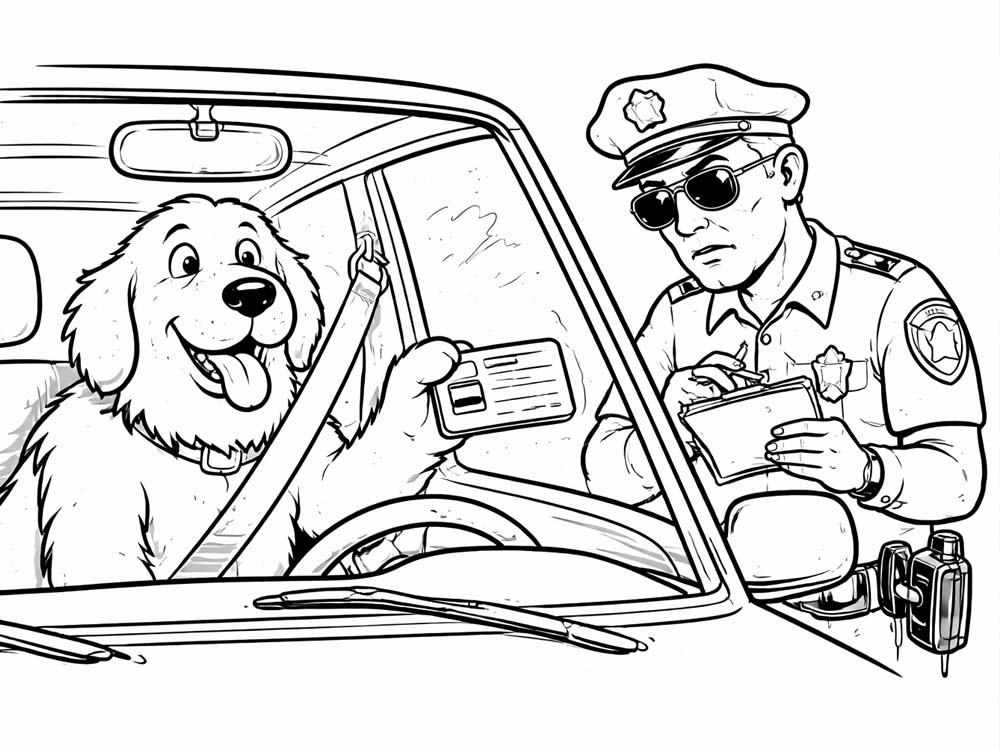
We had a routine traffic stop… until the suspect handed over a license with paw prints. 🐾
This image is doing a lot of quiet work. The dog isn’t panicking. He’s not fleeing. He’s calmly complying—like he’s done this before. Meanwhile, the officer is in full procedural mode, trying to reconcile “standard traffic stop” with “this driver might chase his own reflection.”
That tension—total normalcy meeting total absurdity—is where the best captions lived. The strongest entries didn’t just say “dog driving car” (we all see it). They treated it like a completely real situation… and then let the dog logic leak in at just the right moment.
Let’s break it down.
What We Saw a Lot
A few clear instincts dominated the field:
Police script, dog twist.
Many captions leaned on the classic “License and registration, please” format, adding a canine detail:
- “License, registration and rabies tag, sir.”
- “License and registration, please? And I’m gonna need to see your paw-mit”
- “License, registration, and belly rubs, please.”
This structure works because it grounds the joke in something familiar before introducing the absurd element. It’s a reliable engine—but also a crowded lane.
Dog behavior translated into driving excuses.
A strong cluster pulled from recognizable dog logic:
- “I only ran the light because it looked like a laser pointer.”
- “I’m not drunk, I just naturally swerve toward squirrels.”
- “I swear I only chased one car.”
These work when the behavior feels specific and visual—something we can immediately picture happening behind the wheel.
Wordplay and puns.
There were attempts at bending language:
- “I wasn’t speeding, I was zooming.”
- “This is profiling. I’m being retrievered.”
- “Tail-wagging speed.”
Puns can land, but they’re high risk. If the phrasing calls attention to itself more than the situation, the joke starts to feel constructed instead of observed.
“Good boy” identity jokes.
- “It says right here I’m a good boy.”
This category taps into a universal dog truth, but it needs a fresh angle to stand out.
Missed Opportunities
The image gives you a rare gift: a dog behaving calmly and competently in a human system. Some captions stayed at surface level instead of exploiting that contrast.
For example, several entries described chaos or incompetence (“I regret nothing except not buckling my human.”, “Look, I stopped. Eventually.”). But the image shows the opposite: a composed, almost bureaucratic dog. There’s an opportunity to heighten the humor by leaning into how normal he thinks this is.
Another missed angle: the officer’s perspective. Many captions spoke only from the dog’s voice. But the officer is equally important—he’s the straight man trying to maintain authority in a situation that’s fundamentally ridiculous. A strong caption can live in that tension.
Finally, a number of jokes stopped one beat early. They identified the premise (“dog driving”) but didn’t add a second layer. The best entries added either a twist (unexpected phrasing) or a specific detail (yard, smell, behavior) that made the joke feel complete.
Head to Head
Finalist:
“I’m gonna need you to step out of the vehicle and roll over.”
Non-finalist:
“License, registration, and belly rubs, please.”
Both use the police-command format. Both insert dog behavior. But the difference is precision.
“License, registration, and belly rubs, please.” is additive—it just swaps in a dog element. It’s pleasant, but predictable. You see the joke coming from the first word.
“I’m gonna need you to step out of the vehicle and roll over.” works because it reframes a real command into a perfectly logical dog command. “Roll over” isn’t just dog-related—it’s structurally identical to what an officer might actually say. The joke lands in one clean motion.
It’s tighter, more surprising, and more aligned with the rhythm of a real traffic stop.
Red Lines
“Wow that’s a pretty well trained dog”
This is observational but stops short of being a joke. It names the premise instead of transforming it. A useful rule: if your caption could double as a thought bubble from someone just looking at the image, it probably needs a second beat.
“Look, I stopped. Eventually.”
There’s a seed of character here, but it lacks specificity. What kind of “eventually”? Why? The strongest dog-based jokes lean on recognizable behaviors (chasing, sniffing, digging). Without that anchor, the line feels generic.
“The GPS said ‘take the wheel,’ so I did.”
This tries to introduce a twist, but it pulls in an external concept (GPS phrasing) that isn’t grounded in dog logic or the scene. The connection feels manufactured rather than inevitable. Strong captions tend to feel like they had to be said given the image.
“The carpool lane said I needed a human. I ate him.”
This goes for shock escalation, but overshoots the tone of the image. The drawing is light and procedural, not dark or chaotic. When the tone of the caption doesn’t match the tone of the image, the joke has to work twice as hard—and usually doesn’t.
Winning Captions & Why They Worked
Let’s look at the finalists:
“I’m gonna need you to step out of the vehicle and roll over.”
Clean, immediate, and perfectly mapped to both worlds. It’s a translation joke done right.
“I’m sorry officer, I don’t have a second piece of ID, but you’re welcome to sniff my rear end.”
This one commits fully to dog logic in a human system. The specificity (“second piece of ID”) sets up a formal expectation, and the payoff flips it in a way that feels both absurd and completely on-brand for a dog.
“I have a permit. It’s buried somewhere in the yard.”
Great use of specificity. “Buried somewhere in the yard” is vivid, visual, and unmistakably canine. It extends the world beyond the frame, which makes the joke feel bigger.
“Sir, your breath smells like… everything.”
A subtle reversal. Instead of the officer judging the driver, the dog evaluates the human using dog criteria. “Everything” is a strong, concise payoff—it implies a whole sensory world without overexplaining.
“I swear I only chased one car.”
Simple and effective. It leans on a universal dog behavior and frames it as a legal defense. The humor comes from the mismatch between seriousness and instinct.
Across all of these, a pattern emerges: specific behavior + real-world framing + restraint. None of them over-explain. None of them stack multiple jokes. They pick one clear idea and execute it cleanly.
Final Thoughts
This contest was a good reminder that you don’t need to out-crazy the image—you need to out-precise it. The dog is already driving. The joke is in how seriously everyone is taking it.
The best captions treated this like a normal Tuesday for both parties… just with slightly different definitions of “normal.” Keep looking for that tension: human systems, animal instincts, and the exact moment where they politely collide.
And remember—when in doubt, ask yourself: would this dog actually think this is a reasonable explanation? If yes, you’re probably close.
Now buckle up and head over to the next contest—no license required.