Caption Contest 105: Recap & Review
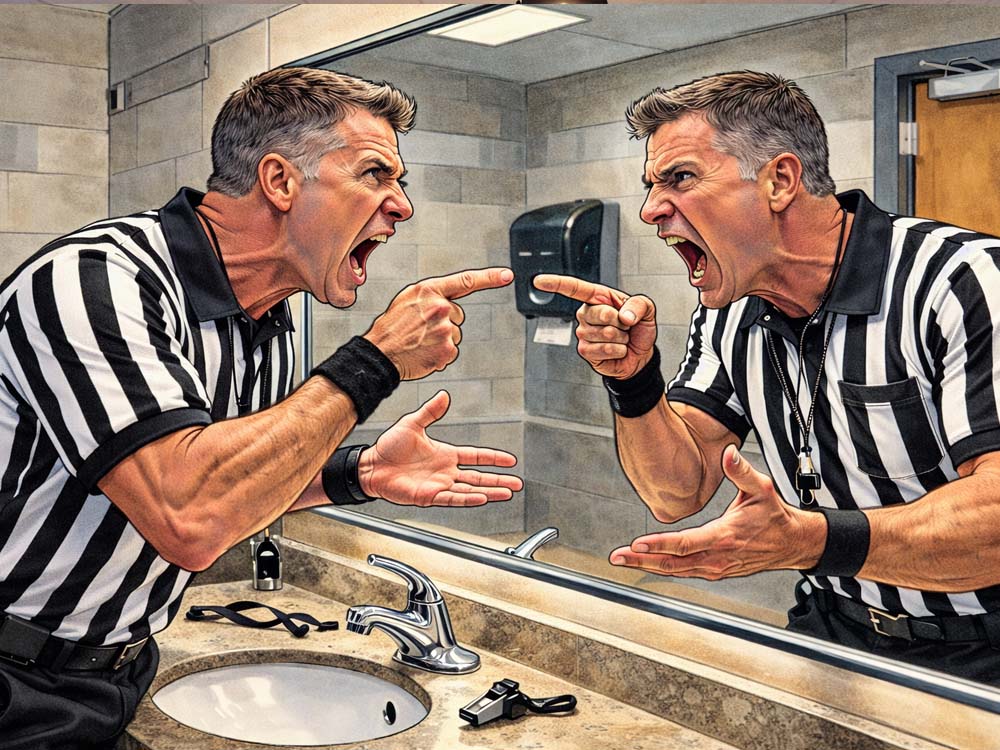
Nothing says “professional authority” like arguing with yourself in a mirror.
This image gave us peak ref energy: whistle around the neck, finger pointed, veins popping, and absolutely zero intention of backing down. The only problem? His toughest opponent is… also him.
It’s confrontation. It’s self-reflection. It’s a one-man instant replay review with no commercial break. A strong visual with built-in tension—and you all came ready to blow the whistle.
What We Saw a Lot
First: puns. So many puns. “Ref-lection,” “ref-lexes,” zebra references, whistles. When the setup hands you a clean word like “ref,” the instinct is to spin it every possible way. That’s natural—and sometimes effective.
Second: generic yelling. A lot of submissions leaned into “You’re out!!” “I make the calls, not you!” “YOUR OUTTA HERE…” The emotional tone fits the image, but the idea often stopped at surface-level anger. We got volume, but not always perspective.
Third: pop culture callbacks. “You can’t handle the truth, Foul!” “Ugh! … you’re killing me, Smalls!” “Ya talkin ta me ya talkin ta me’” These work when the reference meaningfully intersects with the visual. Otherwise, they feel imported rather than discovered.
Finally: authority and self-discipline angles—employee hand-washing, owning mistakes, time-outs. A lot of you explored the referee policing himself, which is a strong conceptual lane.
Missed Opportunities
Several captions were one step away from sharper.
“A double-blind study to prove that neither of us has any idea what’s happening” takes a solid finalist and over-explains it. The shorter “A double-blind study” leaves room for the reader to connect the mirror concept themselves. When you trust the audience, the joke breathes.
“You are the bomb!” and “Man you’re looking good” go positive, which is a fun contrast—but they don’t add a second layer. What about the ref persona makes self-complimenting funny? Push the specificity and it becomes character-driven instead of generic praise.
“I love the nightlife, I wanna boogie, down the disco ride!” is high-energy and absurd, but it doesn’t anchor to the image. The strongest absurd jokes still feel inevitable once you see them. Random ≠ surprising.
Head to Head
Finalist: “A double-blind study”
Non-finalist: “A double-blind study to prove that neither of us has any idea what’s happening”
This is a textbook lesson in restraint.
The finalist works because it’s compact and trusts the reader. The phrase “double-blind study” already implies two unaware participants—perfect for a ref arguing with his reflection. The mirror does the rest of the work.
The longer version adds explanation: “to prove that neither of us has any idea what’s happening.” That clarification flattens the joke. Instead of discovery, we get commentary. Comedy often improves when you remove the sentence that explains the joke.
Red Lines
“I told you he was pigeon toed!
This introduces a third character who doesn’t exist in the image. When a caption forces us to imagine an off-screen scenario unrelated to the visual, it creates friction. If you’re inventing context, make sure it heightens what we already see—not replaces it.
“Screaming, He says to himself: “I SAID, THOSE VEINS ARE SO SEXY POPPING OUT OF MY NECK!!”
There’s a bold commitment here, but the execution piles on intensity without a clean comedic turn. When everything is loud—caps, exclamation, repetition—the joke has nowhere to escalate. Contrast creates laughs; constant shouting dulls them.
“Foul ! Smell that is”
This is playing with the word “foul,” which makes sense for a referee. But the phrasing makes the joke harder to access. Wordplay needs clarity to land. If the reader has to decode structure first, the punchline loses momentum.
“What did i say ? No what did i say ?”
The back-and-forth idea fits the mirror setup. However, for dialogue-based captions, clarity of rhythm matters. If the reader stumbles over the exchange, the comedic timing slips. Dialogue jokes are mini scripts—tight beats matter.
Winning Captions & Why They Worked
Winner-level sharpness showed up in the finalists.
“Looking for a little self-ref-lection”
A classic pun, yes—but it’s clean, readable, and perfectly married to the image. The hyphen does just enough work without overcomplicating it. It’s on-theme and immediate.
“A double-blind study”
As discussed, this one thrives on elegance. It reframes the confrontation as science. That conceptual pivot—from sports rage to clinical research—is what elevates it.
“Whistle while you work on yourself”
This blends a familiar phrase with the ref’s whistle and the self-improvement angle. It’s playful and layered. We get Disney energy colliding with locker-room intensity.
“Mirror mirror on the wall—who’s the fairest ref of all?”
Fairytale language applied to a referee is inherently funny. The word “fairest” does double duty—beauty contest and fairness in officiating. Strong alignment between reference and visual.
And yes, even “Foul ! Smell that is” as a finalist shows how risky wordplay can still break through when the premise is clear. It leans into referee vocabulary and flips it sideways.
Across the board, the strongest captions did one of three things well:
– Made a tight pun that fit perfectly
– Reframed the scenario in a clever new context
– Leaned into the absurdity of arguing with yourself without over-explaining it
Final Thoughts
Arguing with yourself in the mirror is already funny. The job of the caption isn’t to shout louder—it’s to choose the smartest angle of attack.
When the visual is this strong, less really is more. One clean idea. One confident blow of the whistle. Then walk away like you just made the call of the game.
Now go reflect on your next entry—and don’t argue with yourself too long about it 😏
Check out the next contest and take your best shot at making the call.