Tips for Caption Contest 110
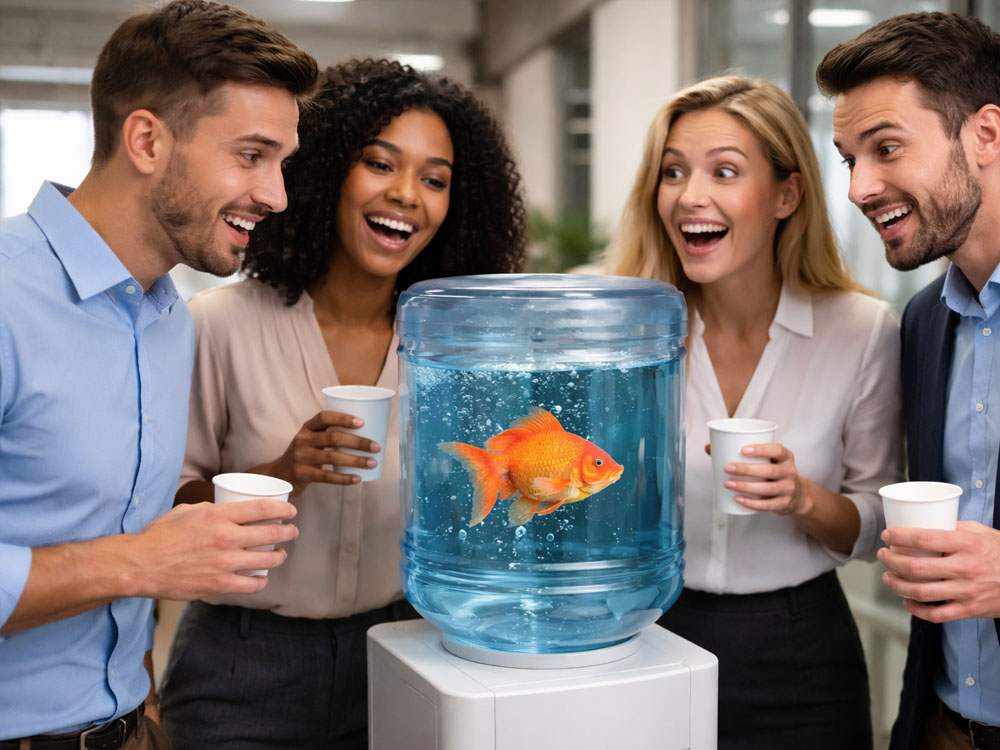
Every office has a water cooler. Fewer have a water cooler that can make eye contact.
You can almost hear the usual conversation topics—weekend plans, passive-aggressive printer complaints, someone “circling back.” And then suddenly: gills. The gossip pipeline now includes bubbles.
This image lives in that perfect workplace comedy zone where nobody screams. They just keep talking. Which means the joke isn’t panic — it’s normalization.
Somehow the weirdest thing in the building immediately becomes part of the meeting.
Getting Started: What’s in the Image?
We’ve got coworkers gathered in a typical break-area huddle.
The setup matters:
-
It’s clearly an office environment
-
People are mid-conversation, not reacting dramatically
-
The fish is fully inside the water cooler
-
The cooler still appears to be functioning as a cooler
That last detail is crucial. Nobody dragged an aquarium in. The office object itself has changed purpose.
Good captions will anchor to the ordinary:
-
workplace rituals
-
small talk habits
-
corporate culture
-
unwritten office rules
Bad captions float away into random animal jokes. The fish isn’t the joke — the workplace adapting to the fish is.
Think Beneath the Surface
The humor engine here is institutional denial.
Offices have a superpower: if something weird happens slowly enough, it becomes policy. The image feels like HR has already scheduled a meeting about it.
Try angles like:
-
corporate language sanitizing reality
-
bureaucracy handling the impossible
-
coworkers treating this as routine
-
productivity continuing no matter what
The best direction isn’t “why is there a fish?”
It’s “how quickly does this become normal?”
Think about workplace behaviors:
-
people pretending nothing is wrong
-
new rules forming instantly
-
passive acceptance over curiosity
-
someone definitely refilling a cup anyway
Example: When the office adapts faster than the employees.
Also explore status dynamics. The fish might outrank them by accident. Or become the only honest participant in the conversation.
Example: The only one not networking.
General Tips on How to Be Funny
Start with the normal, then bend it.
Ground the reader in a familiar office experience before introducing the absurd.
Prefer understatement over shock.
Quiet acceptance beats loud surprise. The image is funny because no one panics.
Let the environment do the work.
Corporate phrasing, meeting language, and HR logic already contain built-in comedy.
Be specific, not chaotic.
Pick one interpretation: policy, gossip, hierarchy, wellness initiative, onboarding, etc.
One idea > five jokes.
A focused perspective lands harder than stacking fish puns.
Write the caption as if the office believes it.
The funnier voice is sincere professionalism applied to nonsense.
Example: New hydration guidelines effective immediately.
Final Thought
This is a classic “absurd becomes routine” image — the office didn’t break, reality did. Aim for the moment where professionalism wins over logic, and the joke will feel inevitable instead of forced.
Now go clock in and submit your caption before the fish schedules your performance review.