Caption Contest 121: Recap & Review
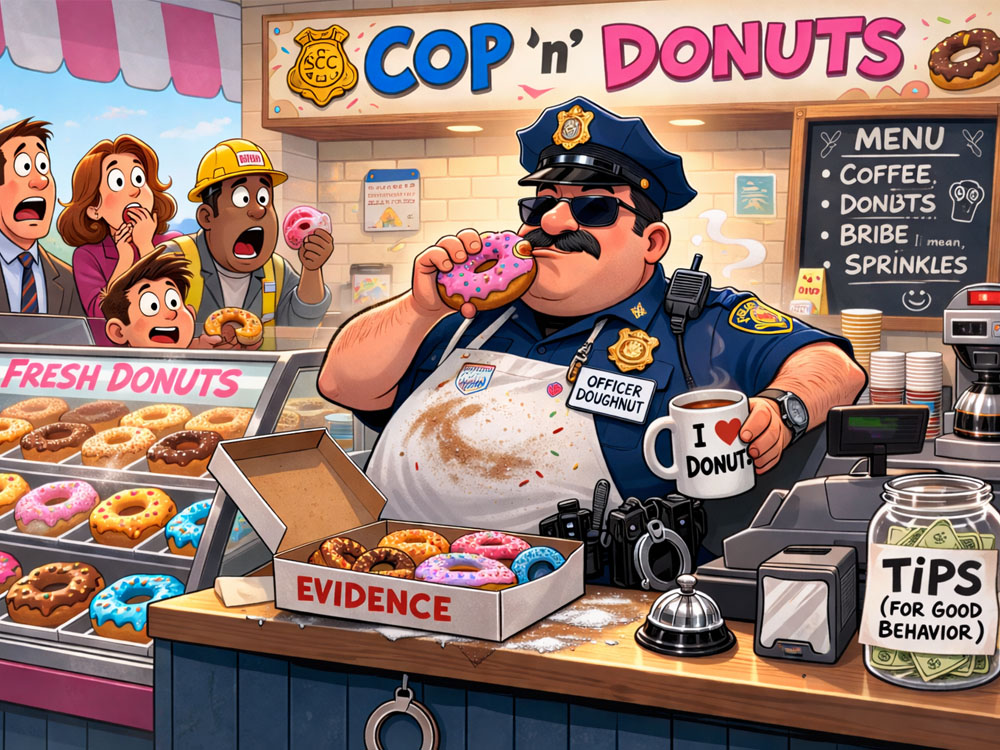
This image walked in with a badge and walked out with a dozen jokes. A cop behind the counter at a donut shop is one of those setups that practically writes itself—which is both the opportunity and the trap.
You’ve got authority meets indulgence. Law meets glaze. Evidence meets… well, evidence getting eaten.
A lot of you clocked that immediately. The best captions didn’t just notice the obvious—they enforced a twist on it.
What We Saw a Lot
Two main lanes dominated the precinct:
First: “eating the evidence.” Variations of cops sneaking donuts, destroying evidence, or being caught mid-bite showed up everywhere:
- “Hey he’s eating all the evidence”
- “Don’t eat the evidence!”
- “I’ll take your order as soon as I can destroy the evidence with sprinkles!!”
Second: pun-heavy police/donut mashups. Words like dough, glaze, cruller, and hole got deputized quickly:
- “Police are investigating a dough-mestic disturbance”
- “Trying to get to the hole truth”
- “Sir, I’m going to need to see some dough-cuments.”
There was also a smaller cluster of “new precinct / internal affairs” jokes and “cop quantities vs baker quantities” ideas.
None of these instincts are wrong—they’re the natural pressure points of the image. But when everyone pulls the same lever, execution becomes everything.
Missed Opportunities
A lot of captions identified the right idea but stopped at the headline.
“Don’t eat the evidence!” is accurate. It’s also exactly what you’d expect someone to say in this scenario. The joke arrives where the reader already is.
The stronger captions added a second move:
- A specific donut reference (cruller, jelly-filled)
- A tonal mismatch (overly serious cop language applied to pastries)
- Or a reframing (turning donut logic into police logic)
There was also room to explore power dynamics more. A cop isn’t just someone who eats donuts—they’re someone who enforces rules. That opens doors: interrogations, warnings, negotiations, absurd authority applied to baked goods.
The image gives you more than “cop likes donuts.” It gives you “cop in charge of donuts.” That distinction mattered.
Head to Head
Let’s compare:
“Step away from the cruller and nobody gets glazed”
vs
“Don’t eat the evidence!”
Both are working the same core idea: donuts as evidence.
The finalist wins because it escalates the premise into a full police standoff. “Step away…” is classic cop dialogue, and “nobody gets glazed” cleverly swaps in donut language without losing the tone.
It’s not just describing the situation—it’s performing it.
“Don’t eat the evidence!” stays at surface level. It names the joke, but doesn’t heighten it. No twist, no added layer, no specificity.
One caption reports. The other commits.
Red Lines
“I make the donuts,I est the donuts , I protect the donuts.”
There’s a solid rhythm idea here—repetition with escalation—but it leans on a familiar structure without adding a fresh angle. The joke would benefit from a sharper turn at the end or a more specific tie-in to policing. When you borrow a known cadence, you need to outpace expectations, not just match them.
“Donuts give me a sugar high so I can arrest the bad guys”
This explains the logic instead of dramatizing it. Comedy tends to work better when the audience connects the dots themselves. Rather than stating the cause-and-effect, show the absurd behavior that implies it. Let the reader make the leap.
“Trump gave us time to eat donuts all day”
This introduces an external reference that the image doesn’t naturally support. When the joke relies on something outside the frame, it risks feeling detached. In tight visual prompts like this, the strongest captions usually mine the image itself rather than importing context.
“I got this!”
This is a classic undercommit. It gestures at confidence, but without a clear angle, the reader has to do too much work. Short captions can work—but only when the idea is unmistakably sharp.
Winning Captions & Why They Worked
“Which is more . . . a Bakers dozen or a Policemans dozen?”
This takes a familiar concept and gives it a clean, logical twist. It’s simple, but it reframes the entire scene. The humor comes from treating “policeman’s dozen” like a real, measurable thing—and letting the reader imagine what that implies.
“Serving up some plain old-fashioned police brewtality.”
A strong pun with layered payoff. “Brutality” becomes “brewtality,” tying coffee, donuts, and policing together in one move. It’s compact, but it connects multiple elements of the scene without overexplaining.
“Step away from the cruller and nobody gets glazed”
Probably the most performative caption of the bunch. It fully commits to the cop voice, uses a specific donut reference, and lands a clean twist at the end. It feels like a line you could actually hear.
“Finally, a precinct where the ‘internal affairs’ are jelly-filled.”
This works because it leans into institutional language. “Internal affairs” is already a loaded phrase in policing, and swapping in “jelly-filled” creates a precise, satisfying contrast.
“Trying to get to the hole truth”
A straightforward pun, but effective because it’s clean and immediately legible. Sometimes simplicity wins—especially when the wordplay is tight.
Final Thoughts
This was a classic case of a high-floor prompt: lots of solid entries, fewer true breakaways. When the premise is obvious, the winners are the ones who push past recognition into transformation.
You don’t get points for spotting the donut. You get points for what you do with it.
Keep looking for that second move—the extra twist, the sharper framing, the more specific detail. That’s how you go from “on theme” to “on top.”
Now go patrol the next contest—there are fresh crimes against comedy waiting to be solved.