Caption Contest 126: Recap & Review
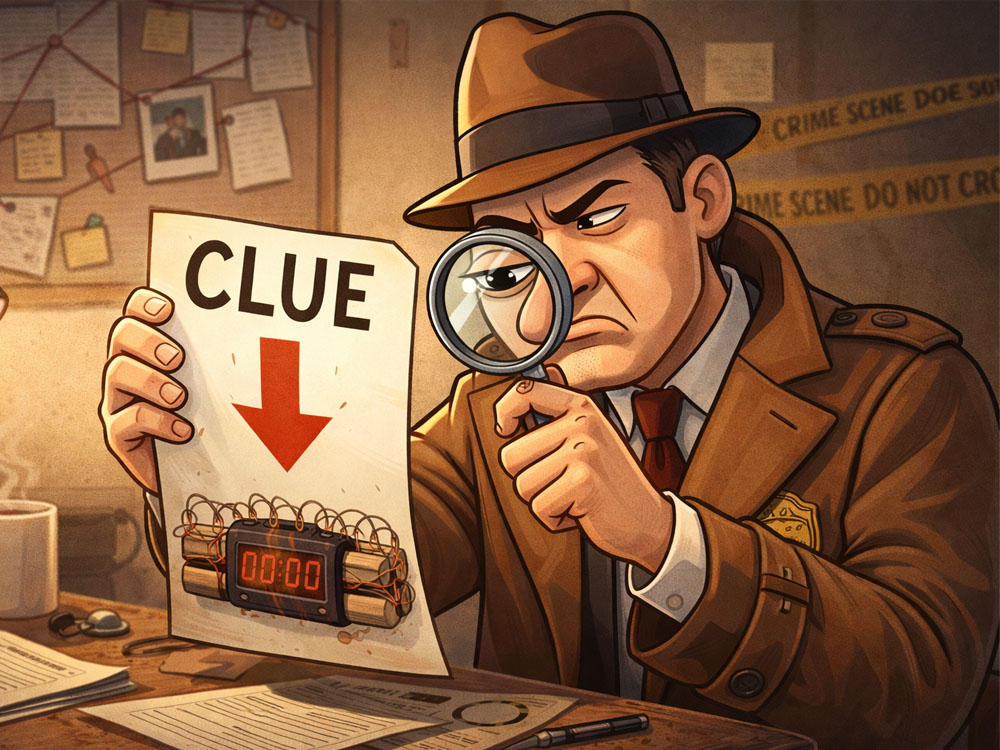
This detective had one job: follow the clues. Unfortunately, one of those clues was actively ticking… and still didn’t make the cut.
There’s something inherently funny about a hyper-obvious danger paired with total obliviousness. It’s the comedic equivalent of a banana peel with a neon sign that says “SLIP HERE,” and someone still stepping on it. This image gave you urgency, irony, and a built-in punchline—time itself.
And as we saw, a lot of you clocked that. Some of you even beat the bomb to the punch.
What We Saw a Lot
Unsurprisingly, most captions gravitated toward time, ticking, and explosions. Words like “blow,” “time,” “ticking,” and “clue” did a lot of heavy lifting across the board.
We also saw a strong instinct toward detective references—especially Sherlock Holmes riffs. “Sherlock Holmesn’t” being the cleanest version of that idea, but others circled the same territory with longer setups.
Another common lane: calling out the detective’s incompetence directly. Variations of “clueless,” “doesn’t have a clue,” or spelling out that he’s missing the obvious were everywhere.
None of these instincts are wrong—they’re actually the right instincts. But when everyone pulls from the same pool, execution becomes everything.
Missed Opportunities
A lot of captions correctly identified the joke (he’s missing a bomb), but then stopped one step short of elevating it.
For example, several entries explained the situation rather than heightened it. “Time will tell—if he ever looks down” gets the premise, but plays it safe. There’s no escalation, no added twist beyond what the image already gives.
Similarly, longer captions like “I think it’s a code…. Somehow written backwards….. aha…. I think I’ve got it! Call me Sherlock” leaned into character voice, but lost comedic efficiency. The humor gets diluted when the setup keeps extending without a sharper payoff.
This image rewards speed. The bomb is ticking—your joke should be, too.
Head to Head
Let’s compare:
“The clue blew the case wide open” (finalist)
vs.
“I have a hunch, something big is about to blow this case wide open” (non-finalist)
Both captions hinge on the same core idea: “blow the case wide open.” But the finalist wins on precision and timing.
“The clue blew the case wide open” is tight, clean, and lets the double meaning do the work. It trusts the reader to connect “clue” and “bomb” without over-explaining.
The non-finalist version adds a full setup (“I have a hunch, something big is about to…”) which softens the punch. By the time we get to the payoff, we’ve already spent the comedic energy.
In short: same idea, different discipline. The shorter one hits harder.
Red Lines
“I knew the clue would be in small letters on the back side. They can’t fool me.”
This is a great example of committing to a character voice—but overshooting the runway. The joke idea (detective overthinking something simple) is solid, but the length and specificity pull focus away from the visual gag. When the image already provides a clear setup, adding layers of explanation can work against you.
“He’s clueless” / “He doesn’t have a clue!”
These fall into the category of true but not transformative. They accurately describe the image, but don’t reinterpret it. A strong caption usually adds a new angle, not just a label.
“What a time to get bombed”
There’s a clever pun buried here, but it leans a bit too generic. “Get bombed” has multiple meanings, but none are anchored specifically to the scene. Without that specificity, the joke feels interchangeable—like it could apply to ten different images.
“Trying to see where Trump put the bomb”
Topical humor can work, but it’s high-risk. Here, the reference doesn’t meaningfully connect to the visual beyond the word “bomb.” When the reference feels bolted on rather than integrated, it tends to lose both clarity and comedic focus.
Winning Captions & Why They Worked
Let’s look at the finalists:
“Sherlock Holmesn’t”
This is pure efficiency. It takes a familiar name, flips it, and instantly communicates incompetence. No setup needed. It’s the kind of joke that feels obvious after you hear it—which is exactly what you want.
“A sharp clue, dull detective”
Nice contrast structure here. “Sharp” vs. “dull” mirrors the visual perfectly. It’s clean, balanced, and lets the phrasing carry the humor without extra explanation.
“The clue blew the case wide open”
As discussed earlier, this one nails the double meaning. It ties directly to detective language while sneaking in the literal explosion. Strong wordplay, well contained.
“Hard to focus with that blasted ticking.”
This is doing something slightly different—it leans into character perspective. The detective acknowledges the ticking, but misattributes it as a distraction rather than a warning. That misread is where the humor lives.
“Has to be a dud”
Probably the driest joke of the group, and that’s why it works. It captures the detective’s misplaced confidence in the face of obvious danger. Understatement is doing the heavy lifting here.
Final Thoughts
This was a strong showing overall, especially in how quickly people identified the core comedic engine of the image. The challenge wasn’t finding the joke—it was sharpening it.
When the visual is this loud (a literal ticking bomb), your job isn’t to compete with it. It’s to either match its clarity or cleverly sidestep it. The best captions here did one of two things: they compressed the idea into something tight and punchy, or they reframed the situation in a way that added a fresh angle.
So next time you see a ticking clock in an image, remember: your caption should beat it. ⏱️
Check out the next contest and see if you can defuse the competition before it blows up.