Tips for Caption Contest 128
This is espionage at its absolute worst—and somehow, its most confident.
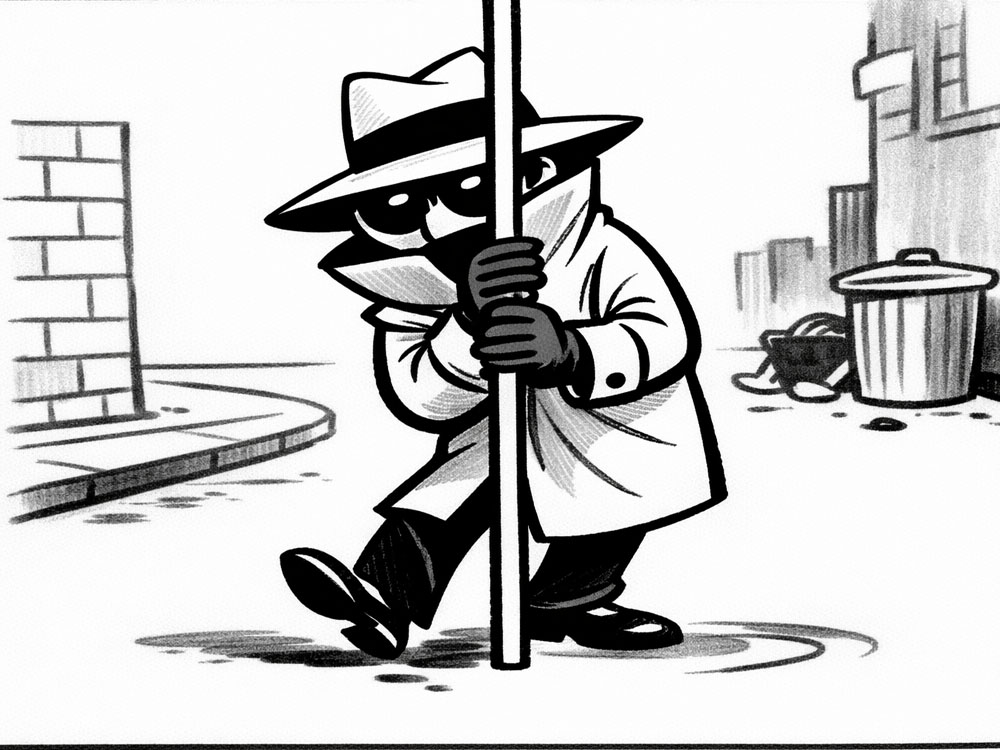
Our spy has chosen a hiding spot that technically exists, but practically does not. The pole is doing its best. The spy is doing… something. And together, they’ve created the least convincing act of stealth ever attempted in daylight.
What makes it funny isn’t just the failure—it’s the commitment. The trench coat. The sunglasses. The posture that says, “I am invisible,” while everything else says, “We can all see you.”
This image lives in that perfect space where delusion meets confidence. That’s your playground.
Getting Started: What’s in the Image?
Let’s ground it.
-
A spy in classic disguise: trench coat, dark sunglasses
-
A very thin pole—comically insufficient for hiding
-
The spy is attempting to conceal their entire body behind it
-
No real environmental cover—just the pole and a lot of exposed human
Key visual tension: the idea of hiding vs the reality of being fully visible.
Also important:
-
The spy’s outfit suggests competence
-
The action suggests the opposite
-
The pole is the “punchline object”—small, rigid, unhelpful
This is a clean, readable setup. No clutter. No confusion. That means your caption has to do the heavy lifting.
Think Beneath the Surface
At first glance, it’s just “bad hiding.” But that’s the surface joke. You’ll want to push past that.
This image is really about false confidence.
The spy believes the plan is working. That gap—between self-perception and reality—is where the strongest jokes live.
You can also explore:
-
Overestimating tools (the pole as “high-tech cover”)
-
Spy movie logic vs real-world logic
-
Performative stealth—looking like a spy instead of being one
-
Denial—the refusal to acknowledge obvious failure
Another angle: treat the pole as if it is effective.
That inversion—where the world agrees this is solid hiding—can unlock stronger, more surprising captions.
Example: “We’ve lost him.”
Or go broader:
-
Corporate strategy
-
Dating behavior
-
Office productivity
-
Childhood hide-and-seek logic
This image scales well. It’s not just a spy—it’s anyone pretending they’re getting away with something.
General Tips on How to Be Funny
1. Target the belief, not the visual
Everyone can see the pole is too thin. That’s obvious. The better move is to write from the spy’s confidence or the world’s reaction to it.
2. Keep it clean and direct
This is a simple visual. Overwriting will dilute the joke. One clear idea beats three clever ones stacked together.
3. Use contrast deliberately
Pair competence with incompetence. Authority with absurdity.
Example: “Standard procedure.”
4. Avoid explaining the joke
If your caption sounds like it’s describing what we already see, cut it. The image has already done that work.
5. Consider perspective shifts
Who’s talking?
-
The spy
-
A handler
-
A bystander
-
The pole (if you’re feeling ambitious)
Changing the speaker can instantly refresh the premise.
6. Escalate the logic
Treat the bad hiding as part of a bigger, coherent system. The more seriously you take it, the funnier it gets.
Example: “Phase one complete.”
7. Specificity beats general cleverness
“Bad hiding” is generic. “Elite stealth protocol” is sharper. Give the joke a frame, not just a reaction.
Final Thought
The strongest captions here won’t just point out the obvious—they’ll commit to a perspective and push it one step further than expected. Trust the simplicity of the image, and let your idea do the work.
Now go hide in plain sight and enter your caption.