Tips for Caption Contest 129
There are few things more inspiring than conquering nature. There are even fewer things more inspiring than thinking you conquered nature.
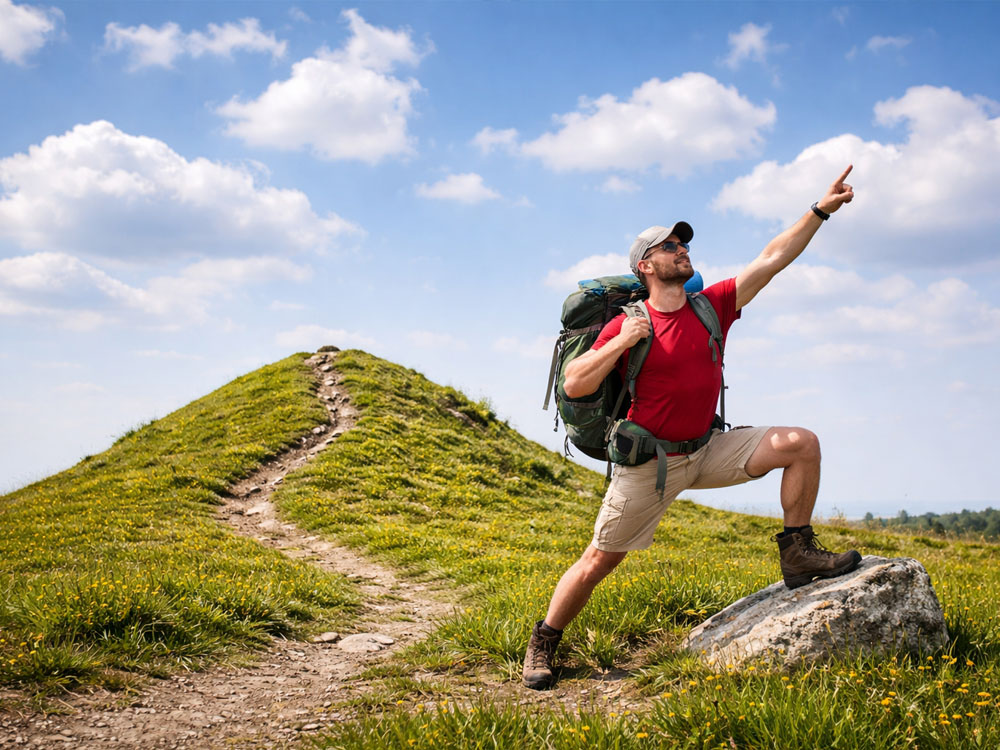
Our hiker has chosen the latter.
He stands tall, chest out, arms likely mid-triumph—next to what can only be described as a hill that politely declined to become a mountain. It’s a pose reserved for Everest. It’s being used for something that could be defeated by a determined toddler.
That mismatch—epic energy, microscopic achievement—is where the comedy lives.
Getting Started: What’s in the Image?
Let’s inventory what we actually see:
- A hiker, geared up for adventure (or at least dressed like it)
- A dramatic, victory-style pose—arms raised, stance wide, possibly mid-yell
- A very small hill. Not a mountain. Not even a respectable hill. More like a suggestion of elevation
- A wide-open outdoor setting that wants to feel grand but is undercut by the scale
Key comedic ingredients:
- Scale mismatch (big reaction, small object)
- Overconfidence / misplaced pride
- Performance vs reality
- Expectation vs payoff
The pose is doing a lot of work here. It tells us how he sees the moment. The hill tells us how we see the moment.
That gap is your playground.
Think Beneath the Surface
This image isn’t just about a hill—it’s about inflated self-importance.
He’s not just hiking. He’s documenting. Celebrating. Possibly imagining a documentary voiceover.
So ask yourself: what story is he telling himself?
- Is this his “hero moment”?
- Is he treating this like a life-changing accomplishment?
- Is he confusing effort with outcome?
Now zoom out further:
This is also about how people frame small wins as monumental:
- Social media exaggeration
- Personal branding energy applied to trivial things
- “Main character” syndrome in a very minor setting
The hill becomes symbolic. It’s:
- A minor inconvenience presented as a major obstacle
- A checkbox achievement treated like a legacy
- A completely unnecessary victory lap
You can also flip perspectives:
- What would a real mountain think of this?
- What would other hikers think?
- What would the hill say if it could talk?
Or go absurd:
- Is this the final boss of a very low-stakes world?
- Is gravity unusually strong here?
- Is this actually a training simulation gone wrong?
The key is contrast. The more seriously he takes it, the funnier it gets.
General Tips on How to Be Funny
1. Play the scale gap hard
Big vs small is the engine. Don’t just mention it—commit to it.
Example: “Day 47: morale is low, but we press on.”
2. Treat it seriously (or don’t—but choose one)
Two strong directions:
- Fully commit to the drama (as if this is Everest)
- Fully undercut it (call out how tiny and unnecessary this is)
Waffling in between weakens the joke.
3. Give him a point of view
Captions land better when they feel like a voice.
Is he proud? Delusional? Exhausted? Filming content?
Pick one and write from there.
4. Add specificity
Generic “small hill” jokes blur together.
Specificity sharpens the image.
Example: “Finally summited the parking lot incline.”
5. Avoid just describing the image
We can already see the joke setup. Your job is to interpret it.
If your caption could double as a caption for any “guy on hill” image, it’s too broad.
6. Use escalation
Start small, then go bigger.
Turn this into a saga, a mission, a historical event.
The disproportion is what makes it hit.
7. Keep it tight
One clean idea beats three crowded ones.
If the joke needs explaining, it’s not ready yet.
Final Thought
The funniest captions here won’t just notice the hill—they’ll understand the mindset of someone who thinks it’s worth celebrating like this. Write from that inflated reality, and let the image quietly prove you wrong.
Enter Caption Contest 129 and show us your best take on the smallest big win.