Tips for Caption Contest 132
Every performer dreams of a crowd. Packed house. Roaring applause. Maybe one guy filming vertically for no reason.
This is not that crowd.
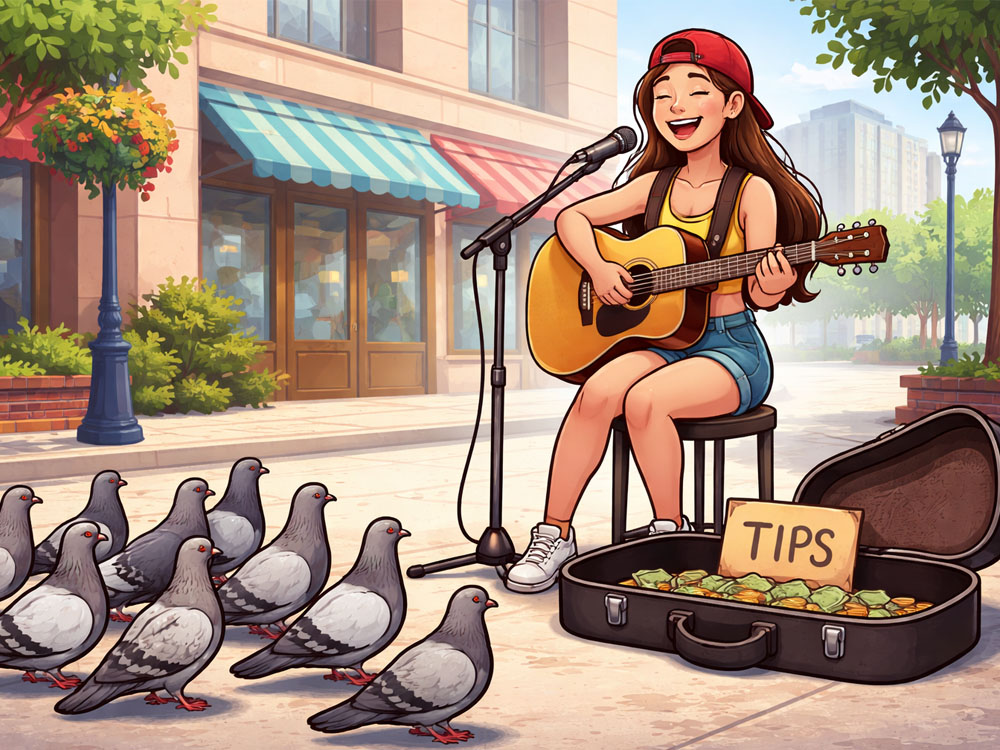
Instead, we have pigeons. Dozens of them. Silent. Judgmental. Possibly more interested in crumbs than chords.
And yet—she plays on. Which raises an important comedic question: is this failure… or is this just a very niche audience?
Getting Started: What’s in the Image?
Start with the literal scene.
A woman is busking—guitar in hand, mid-performance, likely expecting tips, attention, or at least eye contact.
Her audience? Exclusively pigeons. No humans in sight.
Key details to notice:
- The pigeons are numerous, not just one or two
- They’re physically close—this isn’t accidental, it’s a full turnout
- The woman appears committed to performing, not reacting
- The setting likely suggests a public place where humans should be
That contrast—“intended audience” vs. “actual audience”—is the engine of the joke.
Also, pigeons come with built-in associations: urban, indifferent, slightly chaotic, food-motivated. Use that.
Think Beneath the Surface
Now move past the obvious.
This image isn’t just “no one showed up.” It’s “the wrong ones did.”
That opens a few strong directions:
- Reframing success: What if this is actually her target demographic?
- Pigeon perspective: Are they critics, fans, or just waiting for snacks?
- Performer denial: Does she think this is going well?
- Industry satire: Is this what breaking into music feels like?
You can also play with status.
Normally, a musician holds the power. But here, the pigeons might be the gatekeepers. The tastemakers. The ones deciding whether she “makes it.”
Or flip it further: maybe the pigeons are unusually sophisticated, and humans just aren’t ready for her yet.
Example: The only audience that truly understands her music.
General Tips on How to Be Funny
1. Pick a clear perspective
Decide who’s “talking”: the performer, the pigeons, or an outside observer. Blurry POVs weaken the joke.
Example: Tough crowd, but at least they’re consistent.
2. Don’t stop at “no audience”
That’s the baseline. Push one step further—why these pigeons? What do they want? What do they think?
3. Use specificity to elevate
“Birds” is fine. “Pigeons who only pay in crumbs” is better. Specifics create texture.
4. Escalate the absurdity just enough
The image is already funny. Your job isn’t to pile on chaos—it’s to sharpen the angle. One clean twist beats three scattered ideas.
5. Let the contrast do the work
This is a classic mismatch: earnest performance vs. indifferent audience. Highlight that tension instead of explaining it.
Example: Her Spotify algorithm is getting very confused.
6. Keep it tight
Busking implies hustle. Your caption should too. No extra words, no second punchline competing for attention.
7. Avoid over-explaining the pigeons
We already see them. Trust the audience. Use the pigeons as a tool, not the entire joke.
Final Thought
This image rewards precision. The setup is simple, but the angle you choose—failure, delusion, niche success, or pigeon society—determines whether the joke lands. Pick one lane, commit, and keep it clean. The pigeons may not clap, but the voters will. 🐦