Tips for Caption Contest 133
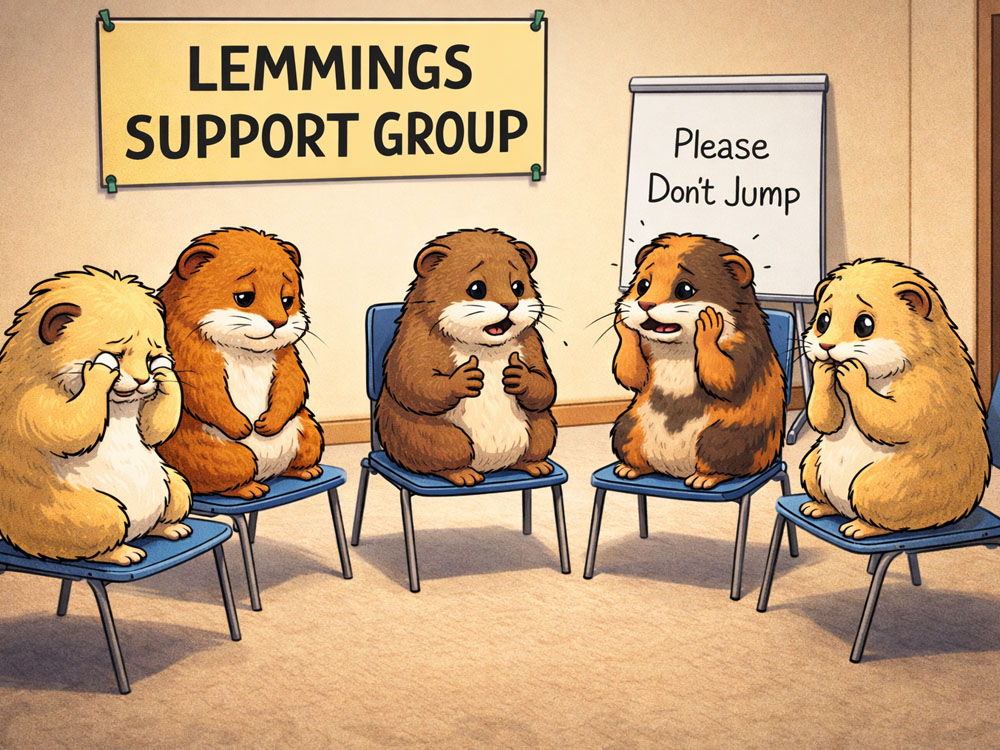
There’s something deeply unsettling about a support group where everyone shares the same extremely specific problem… and the same extremely bad track record.
Five lemmings. A circle. A sign that feels less like encouragement and more like a last-ditch legal disclaimer.
You can almost hear the opening line: “Hi, I’m Lenny, and I have a… pattern.”
This image lives in that perfect comedic space where self-awareness shows up five seconds too late. The intervention has begun—but the cliff is still very much on the itinerary.
Getting Started: What’s in the Image?
Let’s ground it before we spiral (unlike the lemmings, ideally).
- Five lemmings sitting in a circle—classic support group formation
- Neutral, almost clinical setup—like folding chairs and forced vulnerability
- A sign in the background that reads: “Please don’t jump”
- No visible leader, just a shared understanding (or shared concern)
Key comedic details to notice:
- The earnestness of the setup vs. the absurdity of the participants
- The sign is polite, not urgent—suggesting this is a recurring issue
- Everyone is already seated… meaning this is either progress or a pause
- The number (five) feels intimate—this isn’t a movement, it’s a weekly meeting
The humor engine here is contrast: serious human intervention mechanics applied to a group famously known for doing the exact opposite of self-preservation.
Think Beneath the Surface
This image isn’t just about lemmings. It’s about patterns, inevitability, and groupthink—with a soft, furry delivery system.
Some angles to explore:
- Addiction / relapse framing
The language and structure of support groups are familiar. Apply that tone to something inherently doomed. - Groupthink and peer pressure
Lemmings are shorthand for following the crowd. What happens when the crowd tries to stop itself? - Institutional attempts to fix the unfixable
The sign implies effort. Repeated effort. Possibly ineffective effort. - Corporate or bureaucratic parody
This could easily become a meeting, a workshop, a mandated training session. - False optimism
Everyone is sitting calmly… which might be the most suspicious detail of all. - The “we’ve been here before” vibe
The sign doesn’t say “Don’t jump.” It says “Please don’t jump.” That’s the voice of someone who’s tired.
The strongest captions will take one of these lenses and commit to it—rather than trying to juggle all of them at once.
General Tips on How to Be Funny
1. Pick a tone and stick to it
Support groups have a very specific rhythm—earnest, structured, a little rehearsed. Lean into that voice or deliberately break it. Don’t hover in between.
Example: “Today’s goal is to explore alternatives to cliffs.”
2. Let the sign do some of the work
You don’t need to restate the joke. The sign already gives you context. Your job is to twist it, escalate it, or reinterpret it.
3. Specific beats vague
“Bad decisions” is generic. “Cliffs,” “edges,” “group hikes”—those are specific. Specificity sharpens the joke and anchors it in the image.
4. Avoid over-explaining the premise
We all get the lemming reference. If your caption is just explaining that they jump, you’re leaving laughs on the table. Move one step beyond the obvious.
5. Play with roles
Who’s speaking? A facilitator? A participant? An outsider? Changing the perspective can instantly unlock new angles.
6. Use understatement
The situation is already extreme. A calm, clinical tone describing it can heighten the absurdity.
Example: “We’ve identified cliffs as a recurring challenge.”
7. One clean idea beats three crowded ones
Don’t try to hit addiction, corporate satire, and existential dread in one line. Choose one lane and execute it cleanly.
Final Thought
This is a premise built on inevitability—but your job is to interrupt that inevitability with a sharp, specific idea. The fun comes from treating something wildly predictable as if it’s being carefully managed… and maybe, just maybe, failing anyway.
Now go write something that deserves to stay seated.