Tips for Caption Contest 136
This is what happens when the future forgets to delete the past.
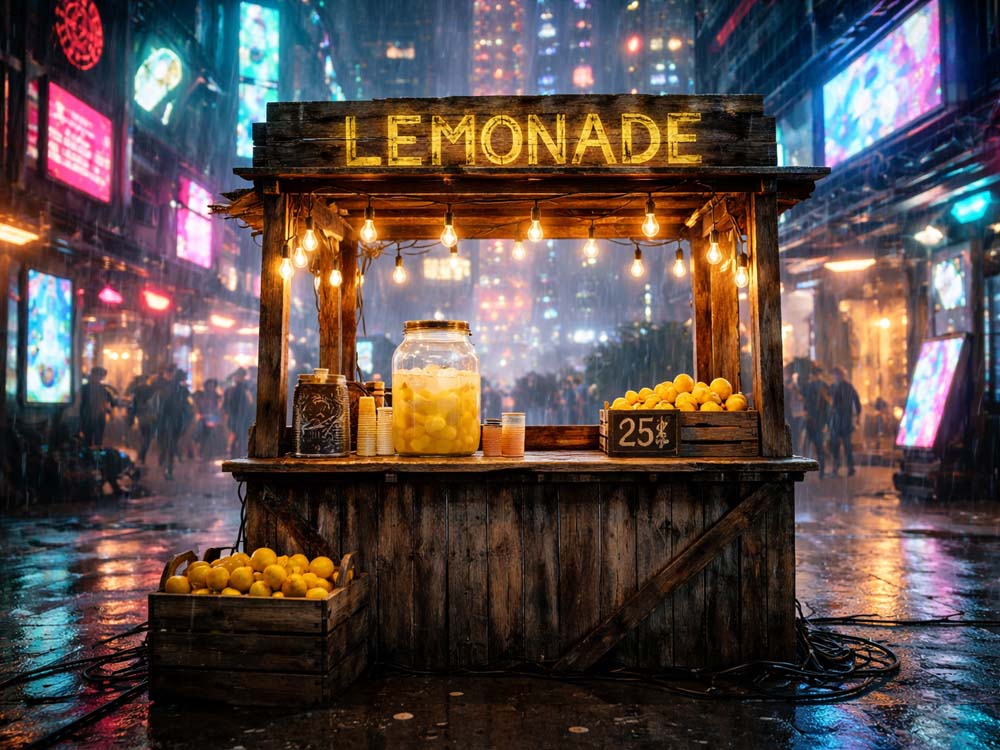
You’ve got towering neon, holograms flickering, drones buzzing overhead—and right in the middle of it all, a wooden lemonade stand that looks like it was built during a summer break in 1997.
It’s not just out of place. It’s aggressively out of place. Like someone copy-pasted “innocent childhood” into a world that runs on microchips and moral ambiguity.
And that clash? That’s where your joke lives.
Getting Started: What’s in the Image?
Let’s inventory what we’re working with:
- A dense, futuristic cyberpunk city—dark tones, glowing signage, high-tech chaos
- Likely rain-slick streets, heavy atmosphere, maybe some dystopian vibes
- And then: a simple wooden lemonade stand
- Handmade aesthetic—rough wood, possibly a handwritten sign, low-tech everything
- No visible upgrades, no neon, no attempt to “fit in”
Key comedic levers:
- Scale contrast: massive city vs. tiny stand
- Tech contrast: advanced world vs. primitive setup
- Tone contrast: gritty dystopia vs. wholesome childhood
Also worth noting: the lemonade stand isn’t hiding. It’s confidently existing in this environment. That confidence can be part of the joke.
Think Beneath the Surface
This image isn’t just “old vs. new.” It’s values vs. environment.
The cyberpunk world suggests:
- Surveillance
- Corporations
- Artificial everything
- Probably a lack of innocence
The lemonade stand suggests:
- Trust (no one’s hacking lemonade prices)
- Simplicity
- Childhood entrepreneurship
- A world where “25¢” is a valid business model
So ask yourself:
What happens when those values collide?
Some angles to explore:
- The stand adapting (badly) to the future
- The future reacting (confused or hostile) to the stand
- The stand secretly thriving because it offers something the future lost
- The kid running it treating this dystopia like a normal suburban street
You can also flip expectations:
Maybe the lemonade stand is the most advanced thing there.
Maybe it’s part of the system in a way we don’t expect.
Maybe it’s the only honest business in a corrupt world.
Or go character-driven:
Who’s running this stand?
A kid? A robot pretending to be a kid? A hardened entrepreneur who just prefers wood over chrome?
The more specific your perspective, the sharper the joke.
General Tips on How to Be Funny
Lean into the contrast.
This image is doing half the work for you. Your job is to point at the gap between worlds in a surprising way—not just say “this is weird.”
Pick a point of view.
Are you the kid? A passerby? A corporate exec? A drone scanning for permits? A strong POV makes the joke feel intentional instead of observational.
Avoid generic “future jokes.”
References to robots, AI, or “in the future…” are easy but often flat. Tie your idea directly to this scene.
Specific beats broad.
Instead of “lemonade stand in the future,” think: pricing model, customers, competition, regulations, or ingredients.
Example: “Now accepting crypto and compliments.”
Let one idea carry the joke.
Don’t stack multiple concepts. Pick the strongest contrast or twist and commit to it cleanly.
Use restraint.
You don’t need to explain the whole world. A tight line that implies the larger absurdity will land harder than a long setup.
Final Thought
This image is a collision of timelines—and the best captions feel like they belong perfectly in that collision, as if they couldn’t exist anywhere else.
Find the one detail that makes you pause, then push it just a little further than expected.
Now go make the future regret underestimating lemonade 🍋