Caption Contest 137: Recap & Review
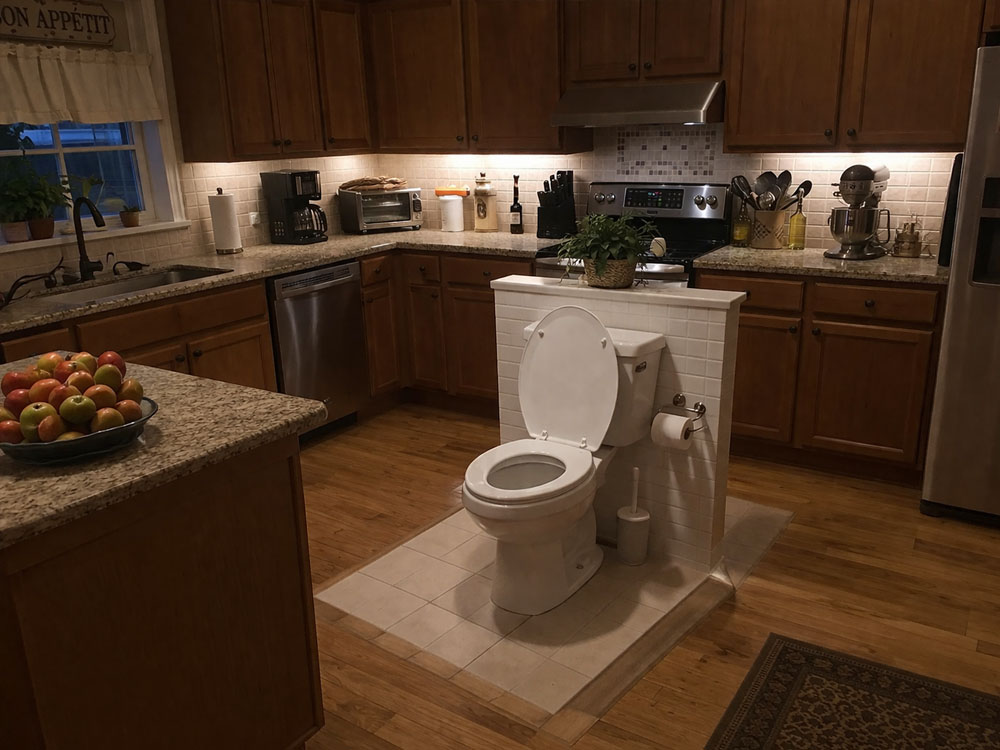
There are open-concept kitchens… and then there are open-concept life choices. This image didn’t just blur the line between rooms—it eliminated it entirely and dared you to keep cooking.
A toilet in the middle of a kitchen is already doing a lot of comedic work. It’s bold, it’s wrong, and it’s… oddly efficient? The humor here lives in that tension: practicality vs. horror. Convenience vs. consequences.
And as we saw, when you give people a toilet next to a stove, they will absolutely cook up some takes.
What We Saw a Lot
The dominant instinct was clear: lean into bathroom humor and food crossover. Lines like “The chef recommends the number two,” “Nothing goes to waste,” and “Extreme garbage disposal installed” all orbit that same core idea—blending digestion with dining.
We also saw a strong thread of efficiency jokes. “This really cuts down on unnecessary trips,” “Finally, a place to multitask responsibly,” and “A full service kitchen” all frame the setup as a weirdly logical upgrade.
Another popular angle: real estate and design commentary. “Listing: ‘Efficiency Studio. $3,500/month. Ample seating near the stove.’” and “Open concept living has gone too far” take the absurdity and ground it in familiar language, which helps the joke land quickly.
And finally, a recurring tone of regret. “Eat, drink, regret, repeat” and “Great for dinner parties, terrible for friendships” capture the social nightmare of this setup.
Overall, strong alignment on the premise. The challenge became: how do you say something new about a very obvious problem?
Missed Opportunities
A lot of captions got close by identifying the core joke—but stopped just short of sharpening it.
For example, several entries leaned on Taco Bell references (“Finally, a kitchen designed for the Taco Bell enthusiast,” “For when Taco Tuesday hits back immediately”). The instinct is solid—fast food consequences map perfectly here—but without a fresh twist or unexpected phrasing, it feels familiar rather than surprising.
Similarly, efficiency-based jokes often described the situation rather than escalating it. “This really cuts down on unnecessary trips” is true, but it plays like an observation. The stronger versions add a layer of irony or specificity that pushes beyond the obvious.
There was also room to explore contrast more aggressively. This image invites tension—clean vs. dirty, appetite vs. appetite loss. The captions that leaned into that clash stood out more than those that simply labeled the setup as bad or weird.
Head to Head
“The chef recommends the number two”
vs.
“Finally, a kitchen that listens to your gut”
Both captions play in the same space: digestion as cuisine. But one is clearly more effective.
“The chef recommends the number two” works because it commits fully to the bit. It uses familiar restaurant language (“chef recommends”) and then lands a blunt, slightly shocking twist. It’s concise, specific, and hits immediately.
“Finally, a kitchen that listens to your gut” is clever conceptually, but softer in execution. It leans on a common phrase (“trust your gut”) without adding enough of a new angle. The connection is there, but the punch is more implied than delivered.
In short: one makes you feel the joke right away; the other makes you think about it for a second—and in captions, immediacy usually wins.
Red Lines
“Here I sit downhearted…”
This opens with a familiar rhyme structure, which signals a known joke pattern. The problem is that it feels incomplete and leans on recognition rather than originality. When a caption reminds readers of a joke they already know, it has to subvert that expectation to feel fresh.
“Kitchen rush”
This is a clean phrase, but it’s too minimal to carry the concept. It hints at a pun (Gold Rush, rush to the bathroom), but doesn’t fully anchor either direction. Short captions can work—but they need either a strong double meaning or a clear image-specific tie-in.
“Cookin go”
There’s an attempt at wordplay here (possibly “cook and go”), but the phrasing is ambiguous. If the reader has to decode the structure before getting to the joke, the momentum is lost. Clarity isn’t the enemy of cleverness—it’s what lets cleverness land.
“No middle time needed !!!”
The idea—eliminating the gap between eating and consequences—is solid. But the phrasing is abstract. “Middle time” doesn’t feel like a natural concept, so the reader has to translate it. The stronger captions in this space used more familiar language (“cuts down on unnecessary trips”) to make the same point more cleanly.
Winning Captions & Why They Worked
“The chef recommends the number two”
This one takes the win for its precision. It’s structured like a standard restaurant recommendation, then flips it with a blunt, slightly uncomfortable punchline. It’s short, clear, and commits fully to the joke.
“This kitchen is just flush with extras”
A strong pun that actually integrates the setting. “Flush with extras” works both as a real estate phrase and a bathroom reference, making it feel more layered than a single-note joke.
“Nothing goes to waste”
Simple, direct, and dark in a way that fits the image. It trusts the audience to connect the dots, which gives it a bit of edge.
“Cooking with gas”
This one succeeds because of restraint. It’s a familiar phrase, but in this context, it picks up a second meaning without overexplaining. The brevity works in its favor.
“Crappy design at it’s finest”
Blunt wordplay, but effective. It labels the situation clearly and uses the pun to reinforce the absurdity rather than carry the entire joke.
Across the finalists, you see a pattern: clarity, commitment, and just enough twist. None of them overcomplicate the premise—they sharpen it.
Final Thoughts
This was a strong field tackling a very obvious (and very tempting) joke. The key takeaway: when the image hands you the premise, your job isn’t to restate it—it’s to angle it.
The best captions didn’t just say “this is gross” or “this is efficient.” They chose a perspective—chef, realtor, system designer—and delivered the joke through that lens.
So next time you’re staring at something wildly impractical, ask yourself: who would defend this? Who would sell it? Who would recommend it?
Because apparently, in this kitchen… someone would. 🚽🔥
Check out the next contest and take your best shot at turning chaos into comedy.