Tips for Caption Contest 137
There are open-concept kitchens… and then there are too open-concept kitchens.
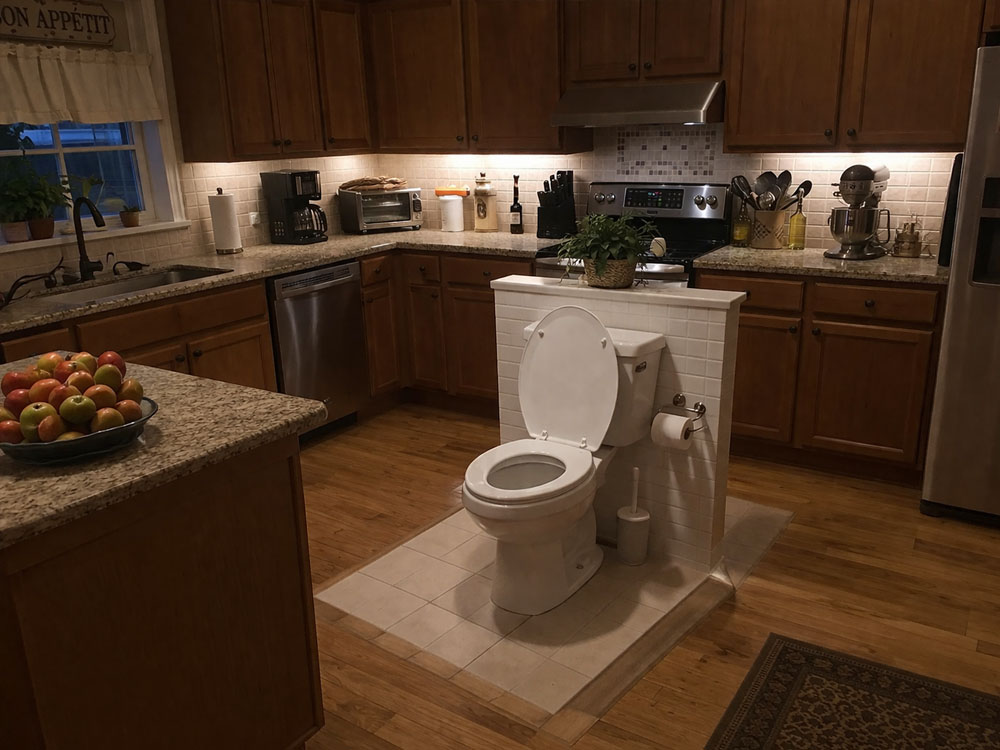
This is what happens when someone takes “multitasking” a little too literally. Dinner’s on the stove, dishes in the sink, and—well—something else is also very much in play.
It’s the kind of design choice that raises more questions than it answers. Who approved this? Who uses this? And most importantly, who’s pretending this is normal?
The image lives in that perfect comedic tension: everything looks like a standard kitchen… except for the one detail that absolutely should not be there.
Getting Started: What’s in the Image?
Let’s inventory the scene clearly:
- A standard kitchen setup: counters, cabinets, appliances, likely a sink and stove.
- Clean, domestic, familiar—nothing chaotic or broken.
- And right in the middle: a fully installed toilet. Not hidden. Not subtle. Center stage.
Key details that matter:
- The toilet isn’t tucked away—it’s prominently placed.
- It appears functional and intentional, not temporary or under construction.
- The rest of the kitchen looks normal, which makes the toilet feel even more wrong.
The humor starts with the contrast: a place associated with cooking and cleanliness colliding with something… decidedly not that.
Think Beneath the Surface
Once you’ve acknowledged the obvious absurdity, push a layer deeper.
What does this mean?
Is this:
- A budget renovation gone wrong?
- A hyper-efficient lifestyle choice?
- A commentary on modern living spaces getting smaller and more chaotic?
Or maybe the joke isn’t about the toilet—it’s about the people who accept it.
Think in terms of:
- Rationalization (“This actually makes sense if you think about it…”)
- Social norms (“We’ve all just agreed not to talk about it.”)
- Marketing spin (“Now with integrated waste solutions.”)
You can also explore perspective:
- A real estate agent trying to sell it.
- A homeowner defending the decision.
- A guest encountering it for the first time.
Or zoom out even further:
- Future living trends.
- Restaurant concepts.
- Cooking shows where this is somehow standard.
The strongest captions often treat the absurd thing as completely normal—or treat it seriously in a way that exposes how ridiculous it is.
Example: “The open-concept bathroom really brings the family together.”
General Tips on How to Be Funny
1. Don’t just point—interpret.
“The toilet is in the kitchen” is an observation, not a joke. Add a perspective, a justification, or a consequence.
2. Pick a clear angle.
Are you:
- Selling it?
- Complaining about it?
- Defending it?
- Ignoring it completely?
Commit to one lens. Mixed angles dilute the punch.
3. Use contrast intentionally.
The humor comes from clashing worlds—clean vs. unclean, private vs. public, cooking vs.… not cooking. Highlight that contrast with precise wording.
4. Keep it grounded.
The more seriously you treat the situation, the funnier it becomes. Let the absurdity do the work.
Example: “Finally, a kitchen that understands urgency.”
5. Be specific, not generic.
Details make jokes sharper. “House tour,” “renovation,” “listing description,” “family dinner”—these contexts give your caption a place to land.
6. Trim the extra words.
If a word doesn’t add clarity or punch, cut it. Shorter captions hit faster and harder.
Final Thought
This image is doing most of the heavy lifting for you—it’s already strange, already memorable. Your job is to choose the right angle and deliver it cleanly. Don’t overcomplicate it. Find the perspective that makes the situation feel just believable enough to be ridiculous.
Now go make something weird feel normal—and normal feel weird.