Caption Contest 138: Recap & Review
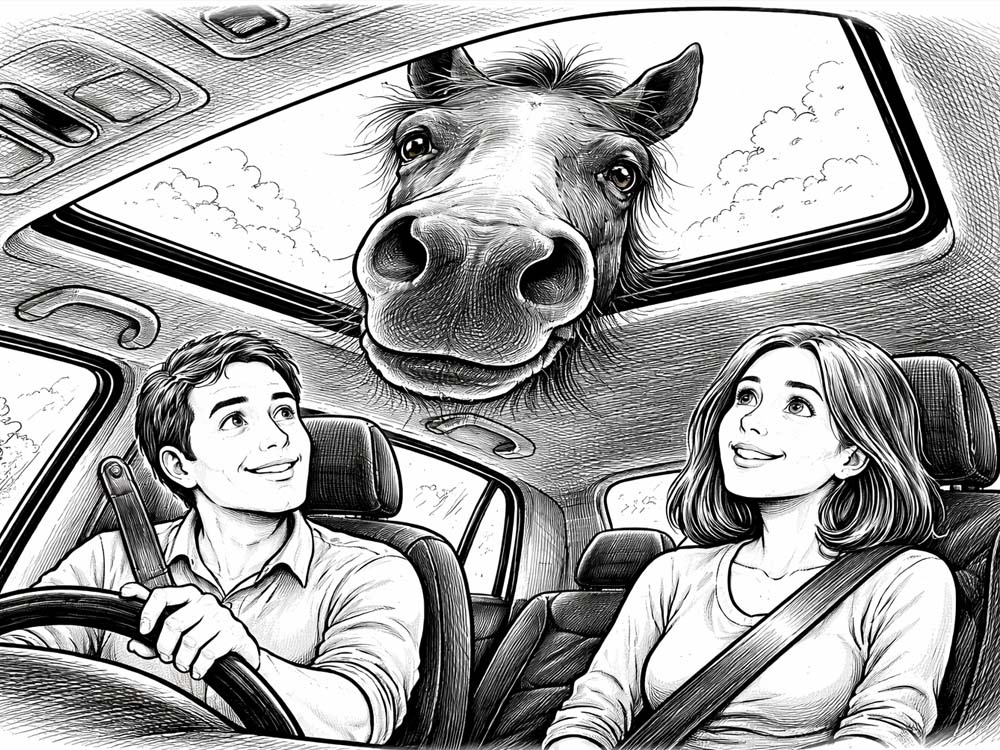
There are surprise passengers… and then there’s this guy.
A horse through the sunroof is one of those images that does half the comedic work for you—unexpected, slightly polite, and just intrusive enough to feel personal. He’s not rampaging. He’s not panicking. He’s just… there. Curious. Present. Judging your playlist.
That tone—calm chaos—is where the best captions lived. The weaker ones treated it like a loud interruption. The stronger ones treated it like a weirdly normal interaction you now have to navigate.
And as we saw, when a horse shows up, the puns follow close behind.
What We Saw a Lot
This was a pun-heavy pasture. You leaned into it hard—horsepower, neigh-borhood watch, stable, stirrup, hoof, hay. The classics got a full workout.
There were also three dominant comedic angles:
- Horse wordplay (the largest group by far)
- Ride-sharing jokes (Uber, upgrades, unexpected drivers)
- Extended warranty bits (because apparently even horses cold-call now)
A smaller but notable group leaned into situational realism—treating the horse like an inconvenience, a carpool violation, or just another Tuesday problem.
None of these directions are wrong. In fact, they’re all good instincts. The difference came down to how fresh the phrasing felt and whether the joke added a specific twist beyond the obvious setup.
Missed Opportunities
A lot of captions got 80% of the way there—and then stopped right at the pun.
For example, “I hoof to say, nice interior” and “Hay there, mind if I drop in” are structurally sound, but they don’t escalate the situation. They acknowledge the horse… and then just sit with it.
This image gives you a built-in absurdity: a large animal casually invading a personal space. The missed opportunity was not heightening that absurdity. What does the horse want? Why is this happening now? What’s the human reaction beyond mild surprise?
Another missed angle: the tone of the horse. He doesn’t look aggressive. He looks… socially confident. Slightly entitled, even. There was room to explore him as a character—less “random horse,” more “guy who does this all the time.”
The best captions moved past the visual pun and into implication.
Head to Head
Let’s compare:
Finalist: “This car has more horsepower than I thought it had.”
Non-finalist: “Don’t worry, I’m just checking your horse-power”
Both use the same core idea—horsepower—but they land very differently.
The finalist works because it’s clean, conversational, and fully grounded in how someone might actually react. It doesn’t over-explain. It lets the visual do the heavy lifting and just adds a light reframing.
The non-finalist, on the other hand, turns the horse into a speaker and stretches the phrasing to fit the pun. “Checking your horse-power” feels constructed rather than observed.
In short: the finalist trusts the image. The other tries to perform the joke.
Red Lines
“I think you pasture turn back there”
This is a good example of a pun overpowering the sentence. When the phrasing bends too far to accommodate the wordplay, the joke becomes harder to process—and humor rarely survives friction. Clean delivery beats clever construction.
“Do you mind if I stick my head in and ruin your day real quick”
There’s a strong comedic instinct here—treating the horse as casually intrusive—but the phrasing runs long and diffuses the impact. The joke would benefit from sharper timing. The faster the turn from normal → absurd, the harder it hits.
“He heard someone say horsepower and took it personally”
Solid premise, but it explains the joke instead of letting it happen. When you narrate the logic, you remove the audience’s role in connecting the dots—which is where a lot of the humor lives.
General takeaway:
- Don’t over-engineer the pun
- Don’t over-explain the joke
- Don’t outtalk the image
Winning Captions & Why They Worked
“This car has more horsepower than I thought it had.”
This is your winner for a reason. It’s simple, immediate, and perfectly aligned with the visual. No extra layers, no strain—just a clean, satisfying click between image and caption.
“You ordered UberX, you got UberE-I-E-I-O”
This one stands out for committing fully to the bit. It takes a familiar structure (Uber tiers) and escalates it into something playful and unexpected. The rhythm helps, too—it’s fun to say, which matters more than people think.
“I hope you’re ready to pony up for gas”
A classic pun, but applied in a context where it feels earned. It works because it ties directly to the scenario (driving, cost, inconvenience) rather than floating independently.
“Sorry, I tend to stirrup trouble”
This one leans into character voice, which gives it a slight edge. The horse isn’t just present—he’s self-aware. That added personality helps the joke feel more active.
“This commute is getting a bit unbridled”
Strong wordplay with a clean tie to the situation. It doesn’t overreach—it just reframes the moment in a slightly elevated way.
Across the board, the finalists share a few traits:
- They’re easy to read once
- They don’t fight the image
- They add just enough, not too much
Final Thoughts
When a horse sticks its head into your car, you don’t need to invent chaos—you just need to recognize it clearly.
This contest was a good reminder that the first idea (horse pun) is often the starting point, not the finish line. The extra step—the twist, the tone, the specificity—that’s what separates a good caption from a great one.
So next time, don’t just saddle up. Take the reins. (And maybe close the sunroof.)
Check out the next contest and see what other unexpected guests show up.