Tips for Caption Contest 147
This is not a drill. This is not a cardigan situation. This is a full-blown textile emergency.
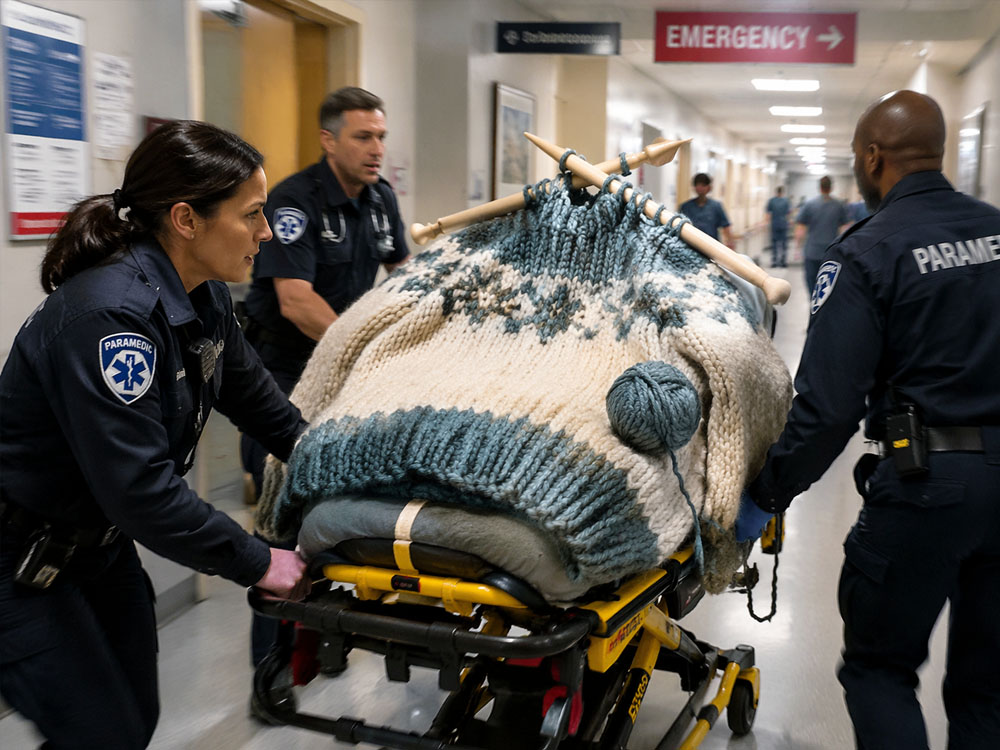
Two paramedics are hustling down a hospital hallway with the urgency of a medical crisis… except the patient is a gigantic, half-finished sweater. Needles still in. Yarn mid-stitch. No time to unravel what went wrong.
The image works because it treats something deeply domestic and low-stakes—knitting—with the visual language of life-or-death urgency. It’s high drama applied to low drama, which is always a strong comedic engine.
Also worth noting: this sweater is not small. This is not “finish it later” energy. This is “this sweater has its own medical chart” energy.
Getting Started: What’s in the Image?
Let’s inventory the scene like a comedy surgeon:
- A hospital hallway — sterile, fluorescent, serious
- Two paramedics — focused, urgent, trained for emergencies
- A gurney — typically reserved for human patients
- The “patient” — an enormous, unfinished sweater
- Knitting needles still actively stuck in the garment
- Yarn trailing, suggesting the process was interrupted mid-creation
The humor hinges on total commitment to the bit. No one in the scene is winking. The paramedics are treating this sweater like it has a pulse.
Key visual details to exploit:
- The scale of the sweater (absurdly large = higher stakes)
- The unfinished nature (something went wrong mid-process)
- The needles (implies danger, urgency, maybe even “injury”)
- The setting mismatch (ER-level response to a craft project)
Your job is to decide: why is this happening, and how seriously should we take it?
Think Beneath the Surface
This image isn’t just “knitting but big.” It’s about misplaced urgency.
We associate paramedics with heart attacks, trauma, chaos. Here, that intensity is redirected toward something soft, slow, and traditionally calm. That contrast is your playground.
A few angles to explore:
- Overreaction: Treating minor problems like catastrophic failures
- Craft drama: Elevating hobbies into life-or-death professions
- Medical parody: Applying hospital logic to non-medical situations
- Escalation: How did knitting spiral this far out of control?
- Anthropomorphism: Is the sweater alive? Is it the victim?
You can also play with language crossover—medical jargon applied to knitting.
Example: The patient is still in stitches
Or flip it:
Example: We’re losing him—switch to purl
Another strong direction is backstory logic. Not just what’s happening, but what led here.
- Did someone knit too aggressively?
- Was this a competitive knitting incident?
- Is this a specialized emergency unit for textile disasters?
The more seriously you justify the absurdity, the stronger the joke.
General Tips on How to Be Funny
Commit to the premise
Don’t half-play the joke. If this is a medical emergency, treat it like one. The straighter you play it, the funnier the contrast becomes.
Use specific language
Generic jokes about knitting won’t land as hard as precise ones. Terms like “stitches,” “patterns,” “yarn tension,” or “unraveling” give you sharper tools.
Example: We’ve got a rapid unravel—prep for stabilization
Lean into contrast
Comedy lives in the gap between expectation and reality. Here, it’s “ER chaos” vs. “cozy hobby.” Keep both sides visible.
Avoid over-explaining
You don’t need to describe the whole scene. Pick one angle—medical, emotional, procedural—and hit it cleanly.
Shorter is stronger
This image rewards tight, punchy lines. One clear idea beats three layered ones competing for attention.
Escalate intelligently
If you’re adding stakes, make sure they feel logically absurd, not random. Build from the image, don’t abandon it.
Example: If this sweater flatlines, winter is canceled
Final Thought
This is a classic “serious people, unserious problem” setup. The more you respect the seriousness, the more the joke does the work for you. Treat the sweater like it matters—and suddenly, it really does.
Now grab your best line and rush it into the ER—this contest is open for submissions.