Caption Contest 148: Recap & Review
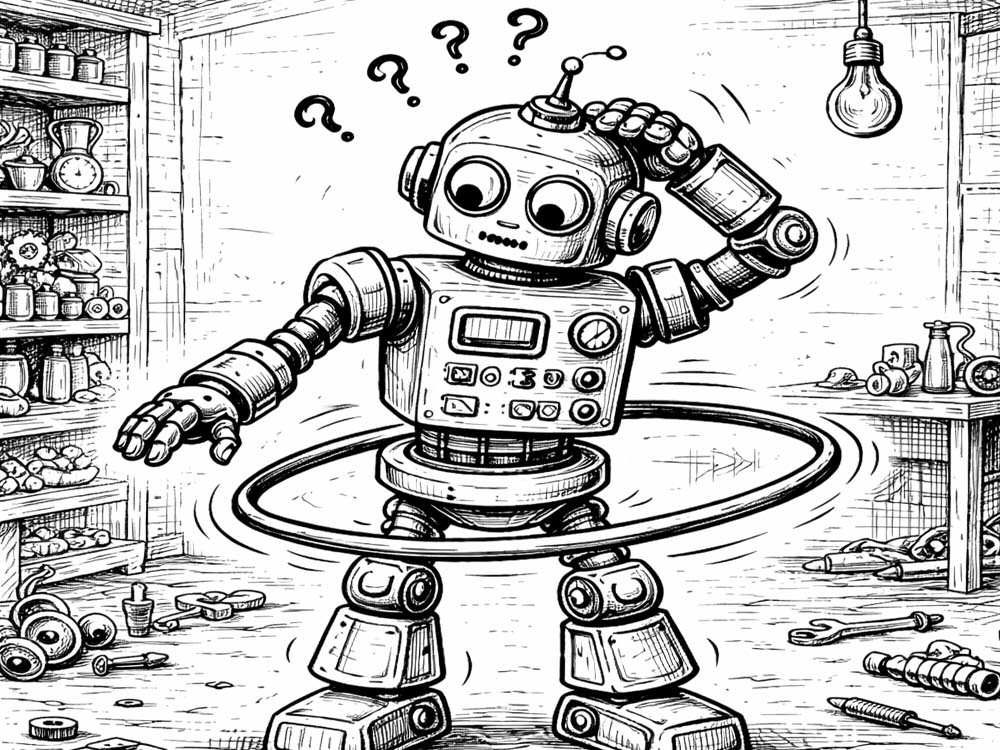
A robot. A hula hoop. Two concepts that, on paper, should not share a sentence—let alone a center of gravity.
This image lives in that perfect comedic sweet spot: high logic meets low coordination. You can almost hear the internal diagnostics firing while the hips… simply refuse to cooperate.
It’s not just a robot trying to hula hoop. It’s a machine confronting rhythm, flow, and the deeply human humiliation of looking uncoordinated in public. Which, as many of you identified, is fertile ground for jokes that spin, loop, and occasionally short-circuit.
Let’s break down what worked—and what got stuck in beta.
What We Saw a Lot
Unsurprisingly, “loops” did a lot of heavy lifting here.
We saw variations on infinite loops, spin cycles, circular logic, and process loops. That instinct tracks—this is one of those rare images where the visual metaphor (a literal loop) aligns cleanly with programming language.
We also saw a strong cluster of “robot vs. rhythm” jokes. Things like glitching hips, lack of groove, or references to music and dancing. Again, a solid read of the image: the humor lives in the mismatch between precision engineering and loose, fluid movement.
There was also a noticeable third lane: wordplay around “core,” “balance,” and “figure.” These leaned more into fitness language than tech, which created an interesting hybrid space—sometimes effective, sometimes a bit stretched.
Overall, the instincts were correct. The challenge wasn’t what to joke about—it was how tightly to execute.
Missed Opportunities
A lot of captions got to the right idea, then kept going.
Take the general category of “loop jokes.” The strongest versions were clean, immediate, and didn’t over-explain. The weaker ones layered on extra phrasing or secondary ideas that diluted the punch.
Similarly, rhythm-based jokes often explained the joke instead of embodying it. The image already shows a robot struggling—your job is to sharpen that contrast, not narrate it.
Another missed opportunity: committing harder to a specific perspective. Is this the robot speaking? A system log? A fitness instructor? A frustrated engineer? The captions that chose a clear voice felt more grounded and intentional.
Finally, a few captions introduced outside references or political angles that weren’t supported by the image. When the visual is this clean, importing unrelated context usually creates friction instead of surprise.
In short: strong premises, but the best jokes here rewarded precision and restraint.
Head to Head
“Currently stuck in an infinite loop”
vs.
“Currently stuck in an infinite spin loop”
Both captions are working the same core idea: the robot is trapped in a loop, mirrored by the hula hoop motion.
The finalist—“Currently stuck in an infinite loop”—wins because it’s cleaner and more aligned with how that phrase is actually used in tech contexts. It’s familiar, instantly recognizable, and lands without friction.
The non-finalist adds “spin,” which feels logically connected to the image but slightly redundant. The visual already gives us the spinning. By naming it again, the caption trades sharpness for literalness.
This is a good example of subtraction making a joke stronger. When the image is doing part of the work, trust it.
Red Lines
“I run on data, not da-da-da-da-da rhythm”
There’s a solid contrast here—data vs. rhythm—but the phrasing stretches to accommodate the joke. The repeated “da-da-da-da-da” calls attention to itself, which slows down the read.
Lesson: if the setup feels longer than the punchline, the joke starts to lose tension. Look for ways to compress without losing the contrast.
“My balance sheet is completely off”
This is a clever pivot into financial language, but the connection to the image is a bit abstract. “Balance sheet” doesn’t visually map as directly to hula hooping as, say, physical balance would.
Lesson: wordplay works best when both meanings feel anchored to what we’re seeing. If one side of the pun floats away from the image, the joke loses traction.
“Just trying to keep my figure… circular”
There’s a nice idea here—linking body shape and the hoop—but the phrasing feels slightly forced. “Keep my figure” is a familiar setup, but “circular” doesn’t quite deliver a surprising twist.
Lesson: when using familiar idioms, the payoff needs to feel like a clean, inevitable flip—not just a technical fit.
“Melania thinks AI means America’s Insurrection”
This one introduces a completely separate context that the image doesn’t support. There’s no visual bridge back to the robot or the hula hoop, so the joke feels disconnected.
Lesson: if the audience has to mentally leave the image to get the joke, you’re likely sacrificing clarity for topicality.
Winning Captions & Why They Worked
“Error 404: Rhythm Not Found”
This is your winner, and it’s doing almost everything right.
It borrows a widely recognized error format and swaps in a perfectly matched concept—“Rhythm.” The structure is familiar, the twist is immediate, and the image reinforces it without needing explanation.
Clean, specific, and fast.
“My core update is still in beta”
This one stands out for its layered wordplay. “Core” works both as a fitness reference and a system update, and “in beta” implies ongoing failure without stating it outright.
It feels natural, not forced, and rewards a second of thought without requiring it.
“This unit was not built for circular logic”
Strong alignment between tech language (“circular logic”) and the literal loop of the hula hoop. It also subtly suggests design limitations, which adds character to the robot.
It’s slightly more formal in tone, but that actually fits the robotic voice.
“Currently stuck in an infinite loop”
As discussed, this works because of its simplicity and direct mapping to both programming and the visual.
No extra words, no extra explanation—just a clean overlap of concepts.
“The AI revolution”
This one is more abstract, but it works as a broader, slightly ironic framing. The “revolution” suggests progress and dominance, while the image shows a robot struggling with a basic human activity.
It’s understated, which helps it stand out among more literal jokes.
Across all finalists, you see a pattern: tight phrasing, strong alignment with the image, and a clear, singular idea.
Final Thoughts
This was a concept where everyone saw the same doorway—loops, rhythm, robots—and the difference came down to who walked through it cleanly.
The strongest captions trusted the image, picked one idea, and executed it without extra wiring. The rest sometimes tried to optimize too many variables at once.
If there’s a takeaway here, it’s this: when the joke is already spinning, don’t add another rotation. Just let it land.
Now go recalibrate your comedic core and take another pass—preferably without triggering a system error. 🤖
Check out the next contest and see if you can keep your humor in the loop.