Caption Contest 149: Recap & Review
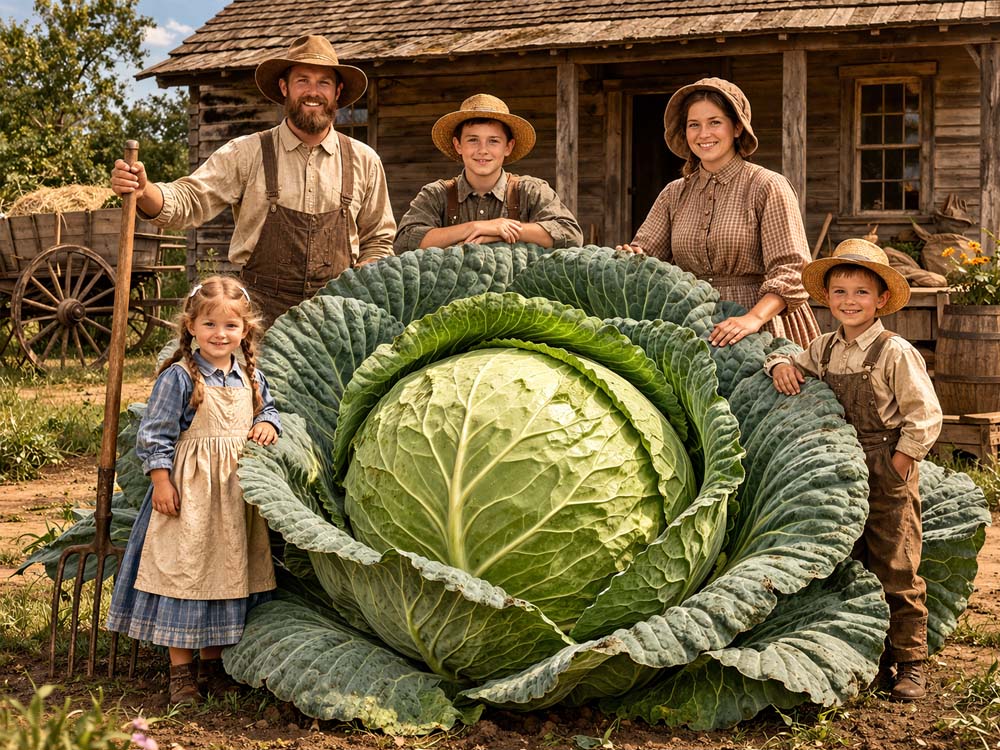
Nothing says “family portrait” quite like standing proudly next to a cabbage the size of your generational expectations.
This image had everything: frontier grit, agricultural triumph, and one deeply unsettling question—how did they get it home? Wheelbarrow? Oxen? Emotional support?
And the captions followed suit. A lot of leafy wordplay, a lot of garden-variety puns, and a few that managed to actually grow beyond the obvious. Let’s dig in.
What We Saw a Lot
Unsurprisingly, the dominant crop this week was produce puns. Variations on “lettuce,” “leaf,” “head,” and “slaw” showed up early and often. You could feel people spotting the cabbage and immediately reaching for the nearest pun on the shelf.
There was also a strong showing of “family framing”—treating the cabbage as either a literal family member or a symbol of one. That instinct aligns well with the image, since the pose is stiff, formal, and portrait-like. It invites anthropomorphism.
A third pattern: escalation attempts. Some captions tried to elevate the cabbage into something mythic (“The harvest that launched a thousand soups”) or symbolic (“root of all their problems”). These aimed for a bigger conceptual swing, but often lost clarity or immediacy in the process.
In short: lots of solid instincts, but many stayed at the surface level of “this is a cabbage, let me pun about cabbage.”
Missed Opportunities
The biggest gap wasn’t effort—it was commitment to a specific angle.
Many captions introduced a premise but didn’t fully explore it. For example, treating the cabbage as a family member is a strong idea, but it needs either a sharper identity (who is it?) or a clearer relationship dynamic. Without that, it reads more like a label than a joke.
There was also room to lean harder into the scale of the cabbage. This thing is absurdly large. A few captions nodded at that, but fewer really exploited the logistical or emotional implications—what it means to grow, harvest, or live alongside something that big.
Finally, some captions tried to blend multiple joke directions—pun + commentary + escalation—and ended up diluting all three. In a one-line format, focus is everything. Pick one strong idea and harvest it cleanly.
Head to Head
Let’s compare:
Finalist: “Head of the household”
Non-finalist: “They finally found the root of all their problems”
Both captions lean into metaphor, using plant anatomy to comment on family structure or dynamics.
“Head of the household” works because it’s clean and immediate. The double meaning of “head” (cabbage head vs. family leader) clicks instantly. No extra framing needed. It also matches the visual—the cabbage is literally centered like the patriarch of the portrait.
“They finally found the root of all their problems” is clever in isolation, but it’s less visually anchored. The idea of “root” doesn’t connect as directly to what we’re seeing, and the phrase itself is more abstract. It requires a half-step of interpretation, which slows the joke down.
In short: the finalist wins on clarity, speed, and visual alignment.
Red Lines
“From small seeds grow… tax problems”
This starts with a classic inspirational setup and then pivots to something unexpected. That’s a solid comedic structure. The issue is the landing. “Tax problems” feels disconnected from the image—it’s a modern, bureaucratic concern dropped into a pioneer setting. The mismatch could work, but here it feels arbitrary rather than intentional. The lesson: when you break tone, make sure the contrast adds meaning, not just surprise.
“Mrs. Johnson agrees bigger is better.”
This is aiming for innuendo, but it’s too vague to fully land. Who is Mrs. Johnson? Why is her opinion relevant? The joke relies on implication without enough context to sharpen it. In short-form humor, ambiguity is risky—if the reader has to fill in too many gaps, the punchline weakens. The lesson: if you’re going suggestive, be precise about the setup so the payoff feels earned.
“The harvest that launched a thousand soups”
This is a nice twist on a familiar phrase, and the structure is solid. The issue is scale mismatch. “A thousand soups” sounds whimsical, but not quite impressive enough to match the grandeur of the original reference. If you’re parodying something epic, the replacement needs to feel equally weighty—or intentionally undercut it in a sharper way. Here, it lands somewhere in between.
“Kale yeah—wait, wrong crop”
There’s a funny meta idea here—acknowledging the instinct to make the wrong pun. But the execution splits the joke in half. First you get the “kale yeah,” then the correction. That second beat explains the joke rather than heightening it. The lesson: meta humor works best when the correction is the punchline, not an add-on.
Winning Captions & Why They Worked
Winner: “Meet the Cabbage Patch Family”
This one dominates for a reason. It taps into a widely recognized cultural reference and maps it perfectly onto the image. The phrasing is clean, the connection is immediate, and it elevates the cabbage from object to identity. It doesn’t just describe the scene—it reframes it.
Finalists:
“Lettuce introduce ourselves”
A classic pun, but executed cleanly. It fits the formal portrait setup and feels like something the family would actually say. That alignment with the scene gives it staying power.
“Romaine calm, it’s just cabbage”
This adds a conversational tone, which contrasts nicely with the stiff visual. The humor comes from treating the absurd as mundane—a reliable and effective angle.
“Head of the household”
As discussed, this wins on simplicity and precision. It’s a tight, visual joke that doesn’t overreach.
“Harvesting Memories”
This one stands out for taking a softer, more sentimental angle. It plays against the absurdity rather than leaning into it, which gives it a different flavor. Not the loudest joke, but a well-composed one.
Across the board, the strongest captions shared a few traits: they were clear, tightly framed, and fully committed to a single idea. No overgrowth, no weeds—just clean comedic lines.
Final Thoughts
This was a fertile prompt, and you all brought plenty to the table. The trick with images like this isn’t finding a joke—it’s choosing which joke to grow and trimming everything else.
When in doubt, remember: one strong idea beats three half-grown ones.
Now go forth, plant boldly, and try not to turn every vegetable into kale—your next caption might just be your biggest hit yet 🌱
Check out the latest contest and see if you can cultivate the winning caption.