Caption Contest 150: Recap & Review
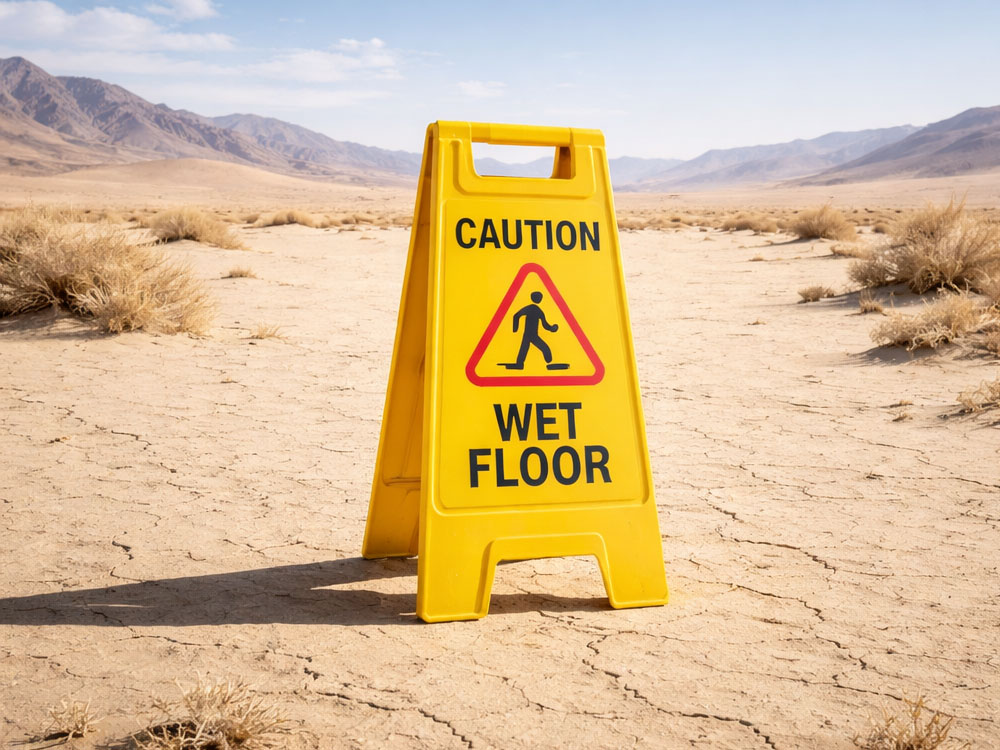
There’s something beautifully pointless about a “Wet Floor” sign doing its civic duty in the middle of a bone-dry desert. It’s the kind of image that feels like it was approved by three committees, printed by a fourth, and placed by a guy who stopped asking questions somewhere around mile 80.
This is comedy built on contradiction: maximum warning, minimum water. A sign designed for liability protection… protecting absolutely nothing. It’s a bureaucratic mirage. And naturally, a lot of you leaned right into that tension—sometimes slipping gracefully, sometimes faceplanting directly onto the sand.
Let’s walk carefully through it.
What We Saw a Lot
The dominant instinct here was “acknowledge the absurdity.” Which makes sense. The image does most of the heavy lifting, so many captions simply pointed at the mismatch:
- Desert vs. wetness
- Warning vs. no actual danger
- Serious sign vs. ridiculous context
You saw a lot of OSHA jokes (“OSHA doesn’t care where you are.” / “OSHA approved”), corporate compliance humor (“Corporate says we still have to put the sign out”), and historical exaggeration (“It rained here once. In 1987.”).
Puns were also everywhere—“Dune worry,” “Oasis you careful,” “Sand by for slippery conditions.” Some landed, some… got stuck in the dunes.
The other noticeable pattern: personification of the system. Captions imagining a facilities manager, a hyper-diligent employee, or some unseen authority insisting the sign must stay. That framing gave the image a human engine, which often helped.
Missed Opportunities
Where things fell short was usually a matter of how far you pushed the idea.
A lot of captions stopped at “this doesn’t belong here,” which is true—but not yet funny. The stronger entries took that premise and added either:
- a specific backstory
- a clear voice (corporate, paranoid, overly cautious)
- or a twist that reframed the sign’s purpose
For example, several captions referenced rare rain events. But “We spilled one drop in 1997 and never took chances again” stays vague. It hints at a story but doesn’t sharpen it. Compare that to something like a fictional incident or consequence—it needs a punchline, not just a premise.
Similarly, some entries aimed for surrealism (“Just in case it rains feelings”) but didn’t fully commit to a defined angle. Absurd can work here—but only if it’s cohesively absurd, not just loosely weird.
Head to Head
Let’s compare:
Finalist:
“A slip-up if I ever saw one.”
Non-finalist:
“Sand by for slippery conditions”
Both are pun-based. Both play with the idea of slipping where you shouldn’t be able to.
The difference is precision.
“A slip-up if I ever saw one.” works because it reframes the entire situation as the mistake. It’s not just wordplay—it’s commentary. The phrasing is clean, familiar, and lets the image do the rest.
“Sand by for slippery conditions” is more mechanically clever but less effective. The pun (“stand by” → “sand by”) calls attention to itself, but doesn’t deepen the joke. It’s wordplay without escalation.
In short: one interprets the image; the other decorates it.
Red Lines
“This sign is in de-Nile.”
A classic pun setup, but it leans on a well-worn joke structure without adding anything specific to the image beyond “desert = Nile reference.” The lesson: if you’re using a familiar pun, you need a second layer—context, twist, or escalation—to justify it.
“Oasis you careful, it’s a real drip hazard”
There are multiple ideas competing here: oasis, caution, dripping. None fully land because the sentence is doing too much. When a caption tries to stack puns, it often dilutes clarity. Pick one strong angle and commit.
“Thesis on creative visualization fails. New thesis on why creative visualization is a Myth”
This one gestures toward an interesting idea—manifestation, expectation vs. reality—but the phrasing is bulky and abstract. Comedy here benefits from immediacy. If the reader has to parse structure before they get to the joke, the moment is gone.
“Welcome to The Twilight Zone. One man’s quench for thirst leads to everlasting desert.”
There’s a tone mismatch. The setup aims for dramatic narration, but the wording doesn’t quite match the cadence or specificity needed to parody that style. If you’re invoking a known voice, it has to be tight enough that we instantly recognize the rhythm.
Winning Captions & Why They Worked
“A slip-up if I ever saw one.”
This is a finalist for a reason. It’s simple, clean, and reframes the entire image in five words. No extra explanation, no clutter. It trusts the audience.
“The mirage has been a slip hazard for centuries. Finally, someone did something.”
This one adds a fictional history, which is a strong move. It treats the absurdity as long overdue problem-solving. The phrase “Finally, someone did something” is doing a lot of comedic work—it brings in modern frustration and applies it to an ancient non-issue.
“The most committed employee of the month, every month, for 40 years.”
A great example of character-driven humor. The joke isn’t about the sign—it’s about the person who insists on maintaining it. That specificity gives the image a human story, which elevates it.
“Corporate says we still have to put the sign out”
This hits because it’s instantly relatable. Anyone who’s dealt with rigid policy recognizes this voice. It grounds the absurdity in reality, which makes it sharper.
“Dry humor, wet warning”
A clean, compact contrast joke. It mirrors the image structure (dry vs. wet) in the phrasing itself. Efficient and on-theme.
Final Thoughts
This was a strong showing overall. The image gave you a clear comedic engine—contrast—and most of you found it. The next step is pushing past recognition into interpretation. Don’t just say “this is weird”—tell us why it exists anyway.
When in doubt, ask: who put the sign there, and what are they afraid of?
Because somewhere out there, in a desert just like this, a very cautious employee is still logging daily safety compliance reports… and frankly, they’re due for a promotion.
Go check out the next contest and see if you can spot the joke before it spots you.