Caption Contest 153: Recap & Review
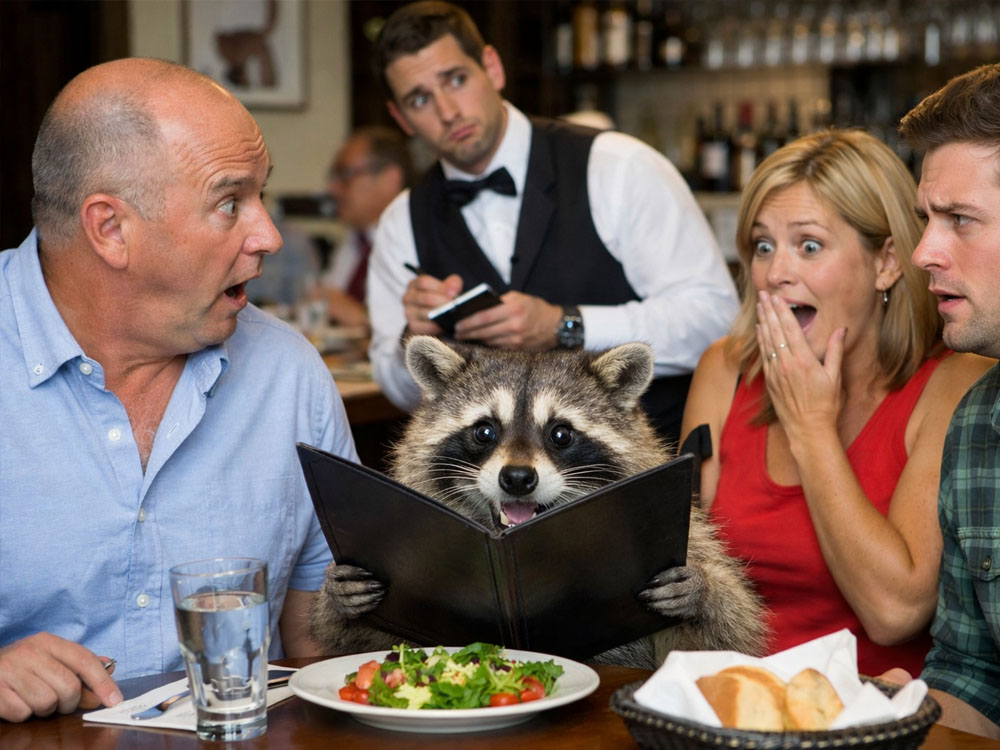
A raccoon at a restaurant table is already funny. A raccoon calmly reading the menu while everyone else short-circuits? That’s a full-course setup.
This image works because the raccoon isn’t chaotic—it’s composed. No stealing, no hissing, no knocking over water glasses. Just… evaluating the options. Meanwhile, the humans are the ones acting like they’ve never seen a paying customer before.
It flips the usual “raccoon as menace” trope into “raccoon as diner,” and that tension did a lot of the heavy lifting for you. The best captions leaned into that contrast—refined behavior vs. trash reputation—and let the joke live right there in the gap.
Also, important: this raccoon didn’t sneak in. It sat down. That’s confidence. That’s a reservation mindset.
What We Saw a Lot
Two dominant lanes emerged quickly.
First: trash-based menu jokes. Lines like “I’ll start with the leftovers and see where that takes me” and “I’m actually here for the chef’s scraps” leaned into the raccoon’s known diet. This was the most obvious angle, and a lot of entries circled here with slight variations—leftovers, garbage, scraps, alleys.
Second: “refined diner” contrast jokes. These played with the raccoon acting like a serious food critic or upscale guest—“He insists on pairing every dish with a garbage can vintage” or “Finally, a table that appreciates my refined palate.” This direction generally performed better because it introduced tension between expectation and behavior.
There was also a smaller cluster of meta or observational lines—“I didn’t know raccoons could read!” or “This raccoon is smarter than all of us”—which tended to land softer. They describe the situation rather than reframing it.
Overall pattern: when captions simply acknowledged the absurdity, they plateaued. When they committed to a premise, they stood out.
Missed Opportunities
A surprising number of captions stayed on the surface of “raccoon = trash.” That’s true, but it’s also baseline knowledge. The image gives you more: posture, setting, social dynamics.
The raccoon isn’t rummaging—it’s choosing. That opens the door to jokes about taste, discernment, entitlement, or even restaurant culture. Lines that treated the raccoon like a passive scavenger missed the stronger angle: this is an active participant in a human ritual.
Another missed opportunity was the reaction of the humans. Three diners and a waiter are all frozen in shock. That’s a lot of social energy to play with—service expectations, awkwardness, denial, customer service politeness under pressure. Very few captions used the humans as part of the joke.
And finally, some entries hinted at a strong idea but didn’t sharpen the language. The premise was there, but the phrasing didn’t land with enough specificity or surprise to separate from the pack.
Head to Head
“The only critic who leaves with the silverware”
vs.
“Finally, a table that appreciates my refined palate”
Both captions lean into the “refined diner” concept, but they execute differently.
“The only critic who leaves with the silverware” works because it introduces a twist at the end. You start with “critic”—a familiar restaurant archetype—then pivot to behavior that snaps you back to raccoon logic. It’s concise, visual, and specific. You can picture the raccoon calmly pocketing utensils.
“Finally, a table that appreciates my refined palate” is a solid idea, but it stays fully in the “refined” lane. There’s no turn. It doesn’t reintroduce the raccoon’s nature in a surprising way, so the tension flattens. It’s clever, but it doesn’t resolve the contrast—it just states it.
The takeaway: when you set up a contrast, pay it off. The best captions don’t just hold two ideas—they collide them.
Red Lines
“Walmart Employment Application”
This one doesn’t anchor to the image. There’s no clear connection between a raccoon reading a menu and a job application, so the reader has to do extra work to find the joke—and most won’t. A caption needs a visible bridge between the image and the idea, even if it’s absurd.
“Slippery when wet”
This feels like a stock phrase dropped into an unrelated scene. There’s no interaction with the raccoon, the restaurant setting, or the social dynamic. When a caption could apply to almost any image, it usually won’t land on a specific one.
“Think”
Minimalism can work, but it still needs a hook. This doesn’t provide a perspective, a twist, or a frame—it just gestures vaguely. Brevity isn’t the goal; precision is.
“I didn’t know raccoons could read!”
This is a pure observation. It points at the joke without adding anything new. As a rule, if your caption could be said out loud by someone standing in the scene, it’s probably not doing enough work.
The broader lesson: specificity beats generality. A caption should feel like it only works for this exact image.
Winning Captions & Why They Worked
“I’ll have whatever they’re having—plus the trash”
This one lands cleanly. It uses a familiar restaurant phrase (“I’ll have whatever they’re having”) and adds a raccoon-specific kicker. The structure is strong: setup, then twist. The “plus the trash” tag is simple but effective—it reasserts the raccoon identity without overexplaining.
“I’ll start with the leftovers and see where that takes me”
A confident voice and a clear premise. It treats leftovers like a legitimate course, which is the joke. The phrasing feels natural, which helps sell the absurdity.
“The only critic who leaves with the silverware”
Probably the sharpest turn in the set. It combines role (critic) with behavior (stealing silverware) in a way that’s both visual and specific. It rewards the reader with a quick mental image.
“I believe this is what they call a walk-in”
A clean, understated pun. It works because it applies a restaurant term (“walk-in”) to a literal raccoon walking in. It doesn’t overreach, and the restraint helps it land.
“I’m sorry, is this not farm-to-dumpster?”
This one plays off a known phrase (“farm-to-table”) and flips it in a way that feels inevitable for a raccoon. The rhythm is strong, and the concept is immediately clear.
Across all finalists, a few traits stand out: clear premise, tight phrasing, and a deliberate collision between human norms and raccoon behavior.
Final Thoughts
This was a concept-driven contest more than a wordplay-driven one. The image handed you a strong premise—your job was to choose the right angle and commit to it.
The best entries treated the raccoon like a character with agency, not just a punchline with fur. They gave it preferences, habits, even a little attitude—and that’s where the humor started to feel specific instead of generic.
If you found yourself stuck in “trash jokes,” you weren’t wrong—you just needed one more step. Add a twist, add a perspective, or bring the humans into it, and suddenly the same idea becomes something sharper.
At the end of the day, this raccoon didn’t come here to scavenge—it came to dine. And the captions that understood that were the ones that got served.
Check out the latest contest and take your best shot at the next unexpected guest.