Tips for Caption Contest 156
This is not your typical “walk into a bar” setup. It’s what happens after the punchline, when everyone sticks around for another round.
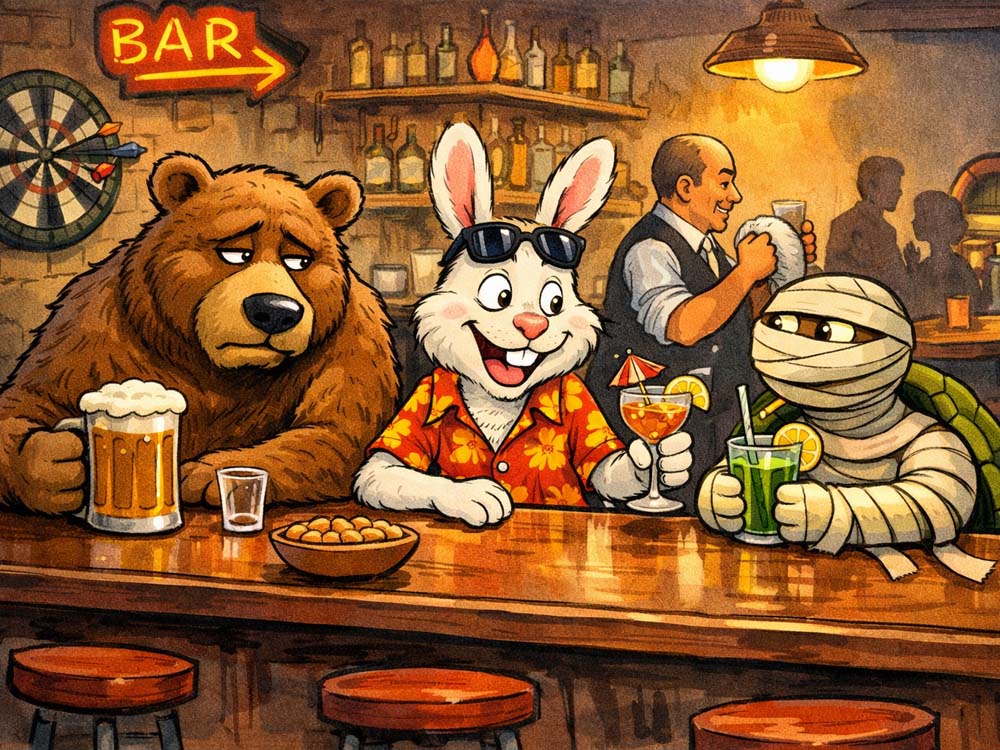
A bear leans in like a regular. A rabbit in a Hawaiian shirt looks like he booked this trip months ago. And a turtle—bandaged, no less—suggests the night already had consequences.
The bartender doesn’t flinch. That might be the funniest part. In a world where this is normal, the absurd has rules.
This image isn’t just weird—it’s casually weird. And that’s where a lot of the comedy lives.
Getting Started: What’s in the Image?
Start literal before you get clever.
You’ve got three animals seated at a bar: a bear, a rabbit wearing a loud Hawaiian shirt, and a turtle wrapped in bandages. Each has a drink in front of them. Behind the bar, a human bartender works, unfazed. Overhead, a glowing neon “BAR” sign anchors the scene.
Details that matter:
- The bear feels heavy, grounded, almost like a regular customer.
- The rabbit’s shirt adds personality—he’s not just a rabbit, he’s on vacation (or acting like it).
- The turtle’s bandages imply a backstory—something already happened.
- The bartender’s calmness suggests this isn’t unusual.
- The neon sign gives it that classic, slightly seedy bar vibe.
Nothing is chaotic. Everyone is composed. That contrast—absurd characters, normal behavior—is your launchpad.
Think Beneath the Surface
Now go one layer deeper.
This isn’t just animals in a bar. It’s a social scene. A post-event hang. A quiet moment after something bigger.
Ask:
- Why is the turtle injured?
- Why is the rabbit dressed like that here?
- Is the bear the leader, the muscle, or just tired?
- Why does the bartender not care?
You can frame this as:
- A crime aftermath (something went wrong)
- A support group in disguise
- A vacation gone off the rails
- A regulars’ night where this is routine
- A fish-out-of-water situation where the human is the odd one out
Also consider tone shifts:
- Play it like a noir scene.
- Treat it like a workplace comedy.
- Frame it as a medical follow-up… happening at a bar.
The key tension: something clearly happened, but no one is explaining it. Your caption can.
General Tips on How to Be Funny
1. Choose a perspective early.
Are you the bartender? One of the animals? An outside narrator? Lock that in. It clarifies the joke fast.
Example: Bartender POV: “We don’t ask questions here anymore.”
2. Explain the unexplained—but only partially.
The turtle’s bandages are a gift. Don’t over-explain the entire story—just reveal one sharp detail.
Example: “And that’s why we don’t let the turtle plan the heist.”
3. Use contrast, not chaos.
The image is already absurd. You don’t need to pile on randomness. Ground your joke in something familiar—bars, vacations, friendships, injuries—and let the characters carry the weirdness.
Example: “Happy hour hit different after the incident.”
4. Make one character the focal point.
Trying to write about all three animals often dilutes the punchline. Pick one and make them the center of the joke.
Example: “The rabbit insisted this was ‘island casual.’”
5. Treat the scene like it’s normal.
Deadpan works especially well here. The less surprised your caption is, the funnier the situation becomes.
Example: “Third time this week.”
6. Be specific, not vague.
“Something went wrong” is weak. “The turtle misread the map” is better. Specificity gives the audience something to latch onto.
7. Keep it tight.
This image rewards restraint. One clean idea, one clear punchline. If you feel yourself adding clauses, you’re probably diluting it.
Final Thought
This is a “quiet chaos” image—nothing is exploding, but everything implies it already did. Your job isn’t to make it louder; it’s to make it sharper. Pick one angle, commit to it, and let the strangeness do most of the work.
Now take your best shot—enter Caption Contest 156 and see if your caption can outdrink the competition.