Tips for Caption Contest 157
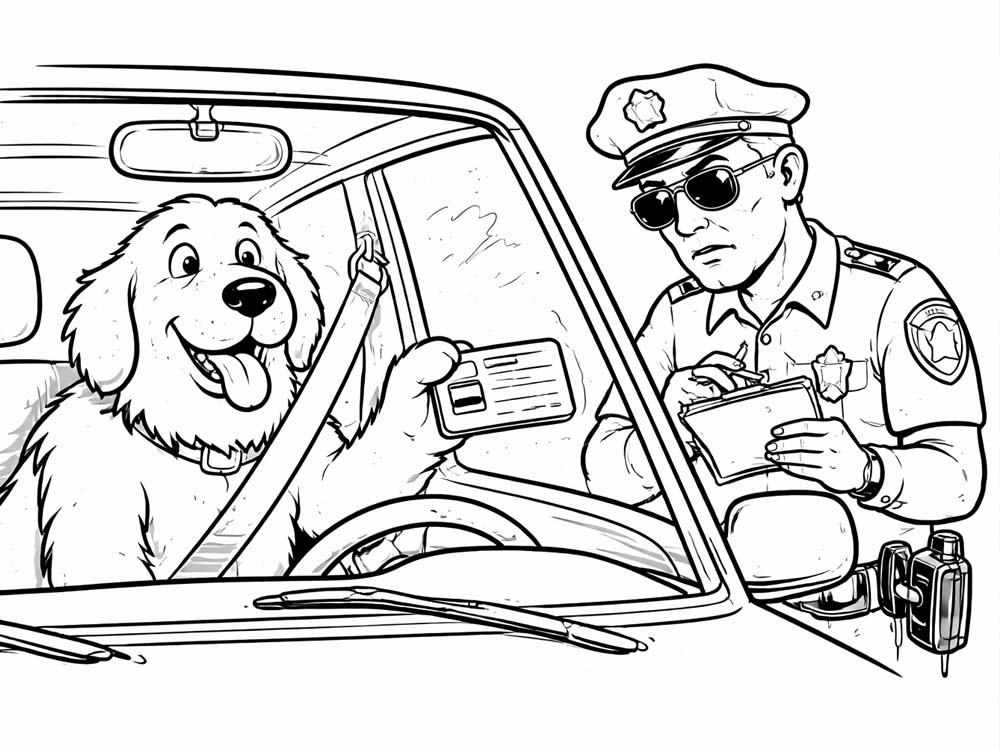
You know you’re having a weird day when you pull someone over and the someone is a dog… who’s fully licensed and not even a little apologetic.
The officer looks like he’s trying to stay professional, but you can feel the internal spiral: Do I ticket this? Do I pet this? Is this a prank?
Meanwhile, the dog is calm. Confident. Maybe even a little smug. This isn’t his first stop.
The joke here isn’t just that a dog is driving—it’s that everyone is acting like this is… mostly fine. 🐶
Getting Started: What’s in the Image?
Let’s ground it.
You’ve got a simple black-and-white line drawing. Clean, minimal—so every detail matters.
- A cheerful dog is sitting in the driver’s seat of a car.
- He’s holding out a driver’s license through the window.
- A police officer stands outside, notepad in hand, mid-interaction.
- The officer looks skeptical, maybe confused, but still going through the motions.
- No chaos, no crash—this is a routine traffic stop… just with the wrong species.
Key comedic ingredients:
- The dog’s calm confidence (he’s not panicking).
- The officer’s reluctant professionalism.
- The total absence of surprise escalation—no one is screaming or running.
- The implied backstory: this somehow checks out enough to proceed.
This is a “normal behavior in an abnormal situation” setup—one of the most reliable joke engines you’ve got.
Think Beneath the Surface
The surface joke is obvious: dogs can’t drive.
So you need to move past that quickly.
What’s more interesting is the logic of this world.
- Has this happened before?
- Is the dog legally recognized as a driver?
- Is the officer questioning the dog… or just the paperwork?
You can also play with roles and expectations:
- The dog as the competent one.
- The officer as the one out of his depth.
- The idea that the dog might be more prepared than most human drivers.
Or lean into systems:
- Bureaucracy blindly accepting anything with the right forms.
- Law enforcement following protocol even when it breaks reality.
- The DMV existing in a universe where this was approved.
There’s also a strong angle in tone mismatch:
- Serious situation + absurd participant.
- Calm demeanor + impossible premise.
Another direction: motivation.
- Why is the dog driving?
- Where is he going?
- What did he do to get pulled over?
The richer your implied world, the sharper your caption lands.
General Tips on How to Be Funny
1. Skip the obvious punchline
If your joke is just “dogs can’t drive,” you’re still at level one. Push to level two: what kind of driver is this dog?
Example: “He insisted on parallel parking to prove a point.”
2. Treat the absurd as normal
The image is already absurd. Your caption works best when it doesn’t react to that absurdity—it builds on it.
Example: “Sir, this license is expired… and also smells like peanut butter.”
3. Give the dog a personality
Confident? Nervous? Overprepared? Arrogant? The caption gets stronger when the dog feels like a specific character.
Example: “I’ve been a very safe boy, officer.”
4. Use the officer as a straight man
Comedy loves contrast. The more grounded the officer is, the funnier the situation becomes.
Example: “I’m going to need you to step out of the vehicle… all four of you.”
5. Lean into systems and bureaucracy
Forms, rules, and procedures applied to nonsense is fertile ground.
Example: “According to the system, he’s cleared for highway driving but not off-leash parks.”
6. Be specific, not generic
“Funny dog driving” is broad. “Dog with a suspiciously legitimate license and a spotless record” is sharper.
Specificity makes the world feel real—and that’s where the humor sticks.
7. Keep it tight
One clean idea beats three crowded ones. If your caption needs explaining, trim it.
Precision > volume.
Final Thought
The best captions here don’t just notice the joke—they extend the world where this makes sense, just enough to make the reader believe it for a second before it collapses.
Now take the wheel and give it your best shot—enter Caption Contest 157.