Caption Contest 88: Recap & Review
Caption Contest 89: Recap & Review
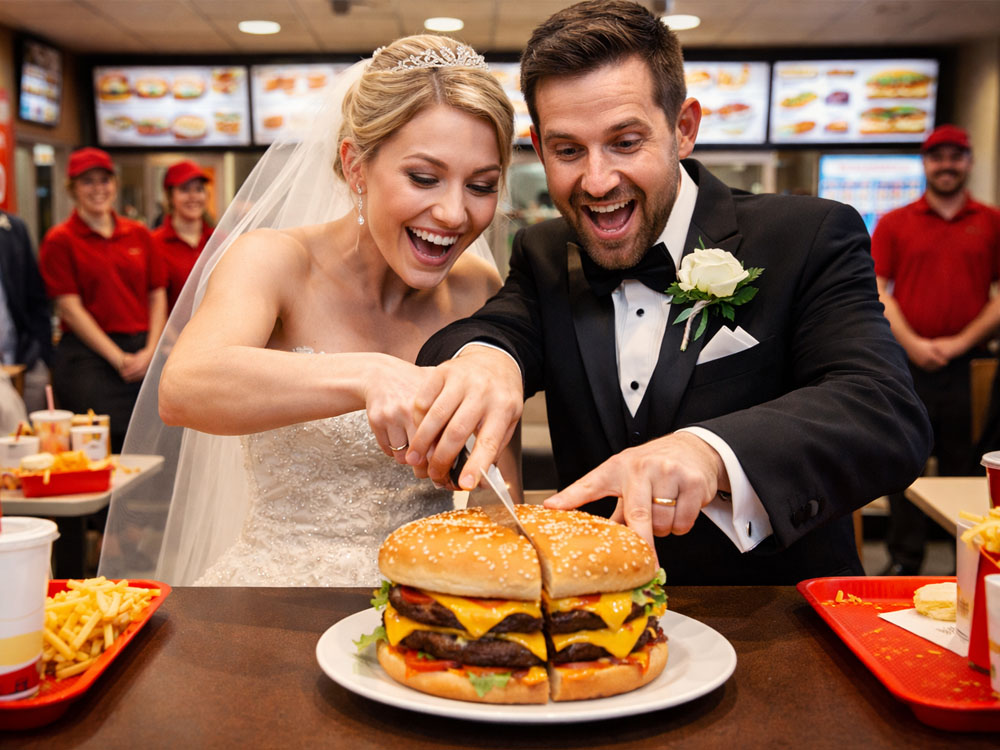
Nothing says “eternal love” like sesame seeds gently cascading onto a paper wrapper.
This image had everything: formalwear, fluorescent lighting, and a bride and groom delicately slicing into a cheeseburger like it’s a five-tier fondant masterpiece. It’s romance. It’s cholesterol. It’s legally binding.
The contrast is doing most of the comedic heavy lifting here. Veil and bouquet meet value menu. Champagne dreams meet fountain drinks. And you all showed up ready to ketchup. (Sorry. Had to.)
Let’s unwrap what worked.
What We Saw a Lot
The dominant flavors were clear:
-
Fast marriage vs. fast food
“Fast food wedding, hopefully it won’t be a fast marriage” leaned into the obvious but reliable wordplay lane. -
Beef jokes
“Five minutes after marriage, and this couple already has beef with each other.” was one of the strongest executions of that instinct. -
Mc-Word mashups
“Holy Mac-ramony”
“A Beautiful McWedding”
“Introducing the new”Mcprenuptual” meal at McDonald’s. Everythings 50/50.” -
Splitting everything / prenup angles
“We will split half of everything”
“And that’s how we’ll split it all!” -
Cake fake-outs
Variations on “The happy couple cuts the wedding cake.” and “Time to cut the wedding cake.”
Most writers correctly identified the core tension: this is a wedding ritual performed in the least romantic culinary setting imaginable. That instinct was right. The separation came down to specificity and twist.
Missed Opportunities
A few captions were circling strong ideas but didn’t quite commit to the bite.
Several “this is the wedding cake” jokes simply described the image without adding a new layer. For example:
“The happy couple cuts the wedding cake.”
It acknowledges the visual, but the humor depends entirely on us noticing it’s a burger. There’s no added perspective, exaggeration, or escalation.
Similarly, general commentary like:
“Wow this a huge burger think we can eat it all”
doesn’t anchor to the wedding premise. It treats the burger as just a burger. The comedy here lives in the ceremony of it.
A stronger version of the “split everything” concept might have pushed further into divorce court, prenups, or custody of the fries. The idea was fertile; many entries stopped at surface-level 50/50 jokes instead of heightening.
Head to Head
Let’s compare:
Finalist:
“The happiest meal of their lives”
Non-finalist:
“It’s really a wedding cake !”
The finalist works because it reframes a familiar brand phrase (“Happy Meal”) into something emotionally resonant. It’s clean. It’s concise. It requires the reader to connect the dots. That mental click is the laugh.
The non-finalist simply points out the visual twist. It tells us what we’re already seeing. There’s no additional angle or wordplay beyond the obvious.
In short: one transforms the image; the other labels it.
Red Lines
“Burger for a wedding cake lol !”
Lesson: If the punchline could be replaced with “Isn’t that funny?” it’s probably not finished. Stating the joke isn’t the same as constructing one. Add a perspective, a consequence, or a twist.
“Meet Mr and Mrs Meat”
This is a solid rhyme instinct, but it stops just shy of a full idea. Wordplay alone rarely carries the joke unless it introduces a new image or implication. What does being “Mr and Mrs Meat” suggest? A butcher dynasty? A carnivore covenant? Push it one step further.
“Made with AI sauce.”
This one veers away from the image. There’s no clear connection to weddings or burgers beyond “sauce.” Topical references can work, but only when tightly tied to what we’re seeing.
“Surround one’s self with greatness and greatness will surround one’s self”
This is a motivational poster that wandered into the wrong reception. Tone mismatch is a common trap. Make sure your joke lives in the same universe as the image.
Winning Captions & Why They Worked
Winner-tier energy came from strong, clean wordplay with a clear hook.
“A Beautiful McWedding”
Simple. Brand-specific. Instantly visual. It fuses the corporate setting with the ceremonial moment without overcomplicating it.
“Introducing the new”Mcprenuptual” meal at McDonald’s. Everythings 50/50.”
This one layers the joke. It combines a brand parody with a marriage-specific concept (prenups) and ties it to the literal act of splitting the burger. That’s alignment.
“Five minutes after marriage, and this couple already has beef with each other.”
This is a classic double meaning done well. “Beef” fits both the burger and marital conflict. The timing phrase (“Five minutes after marriage”) adds narrative and escalation.
“Holy Mac-ramony”
Short, punchy, and brand-aware. It lands because it sounds like something you’ve heard before, twisted just enough to feel clever.
“When you order “The One”… and a Side of Fries”
This finalist stands out for layering romance language (“The One”) with drive-thru ordering logic. It creates a full sentence with a sharp pivot at the end.
And of course:
“The happiest meal of their lives”
Restrained. Brand-adjacent. Emotional misdirection. It trusts the audience to make the connection, which always feels smarter than spelling it out.
Final Thoughts
This contest proved something important: you all understand the core joke structure. The next level is sharpening it.
When you spot the obvious tension—wedding vs. fast food—ask yourself: What’s the most specific, slightly unexpected consequence of that tension? Custody battles over condiments? Anniversary specials? In-laws judging the fries?
Keep cutting deeper. Preferably with a plastic knife.
Now go RSVP to the next contest and see if you can serve up something even juicier.