Caption Contest 128: Recap & Review
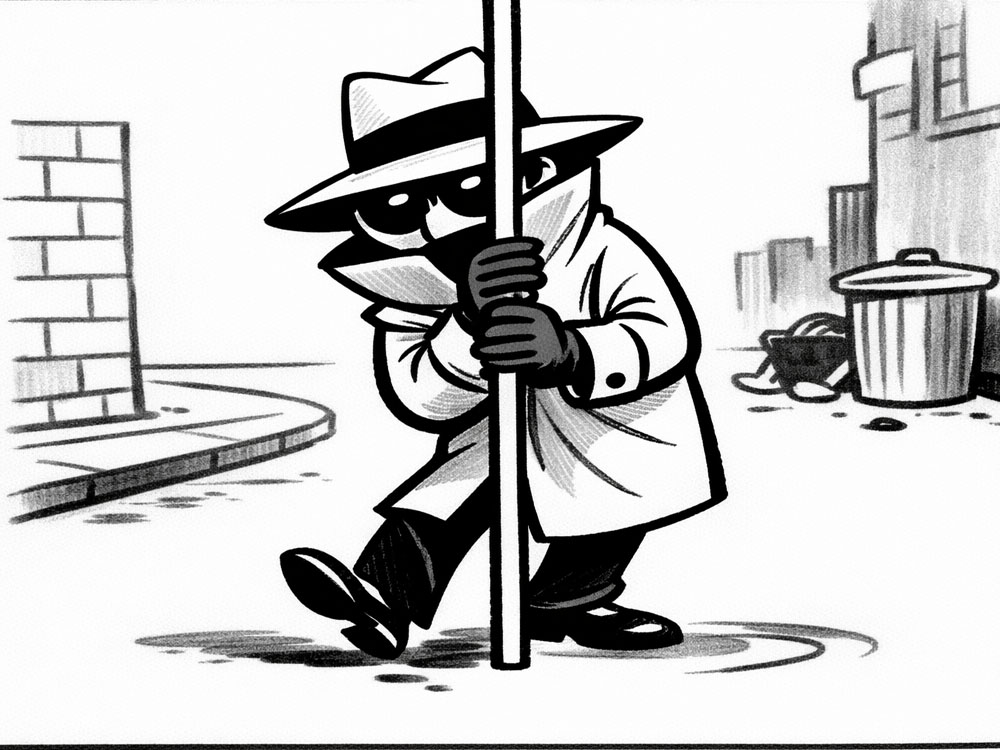
This spy understood the assignment—unfortunately, the assignment was “hide behind something,” and the options were… limited. What we got instead is a trench coat, a pair of sunglasses, and a pole doing absolutely none of the heavy lifting.
There’s something inherently funny about confidence completely outpacing reality. This isn’t just bad hiding—it’s committed bad hiding. The kind where you’re 100% sure you’ve nailed it, while 100% of your body remains visible.
And that gap—between intention and execution—is exactly where a lot of the best captions lived this week.
What We Saw a Lot
A clear pattern emerged: most captions locked onto visibility vs. invisibility. That’s the core joke baked into the image, and many of you correctly circled it.
We saw variations on:
- “You can still see me” logic (“Now you see me… actually you still see me”)
- Partial success framing (“Technically, my left ear is completely invisible. That’s a 50% success rate.”)
- Budget/tech metaphors (“Stealth mode: buffering”, “The invisibility budget was cut”)
There was also a strong secondary lane of wordplay around “pole”:
- “A pole-ish bandit”
- “Pole Dancer or Really Bad Spy?”
- “A pole-dancing sleuth practices in the alley!”
And finally, a smaller cluster leaned into spy tropes—private eyes, disguises, stealth modes—trying to fuse classic espionage language with the visual absurdity.
Overall, the instincts were solid. Most captions correctly identified that the joke isn’t just “bad spy,” it’s “bad spy who thinks he’s good.”
Missed Opportunities
Where things occasionally fell short was in precision of perspective.
The strongest captions chose a clear point of view:
- Either the spy narrating his own delusion
- Or an observer calling out the obvious failure
Some of the mid-tier entries hovered between those perspectives, which diluted the punch. For example, “Pole Dancer or Really Bad Spy?” frames it as a question—but the image itself already answers that question definitively. When the audience has to do extra work to land the joke, the laugh weakens.
Another near-miss area was over-expanding the premise. A line like “When I took this spy job, they didn’t tell me it would split me into two frames.” introduces a new concept (frames/splitting) that isn’t visually anchored strongly enough. The image is simple. The joke should feel just as immediate.
Finally, some captions leaned on wordplay first, image second. “A pole-ish bandit” is clever linguistically, but the connection to spying and concealment isn’t doing enough work beyond the pun. When the pun becomes the whole engine, it needs a tighter link to the visual.
Head to Head
Let’s compare:
“Master of disguise, minor in geometry”
vs.
“A pole-ish bandit”
Both rely on wordplay, but they operate very differently.
“Master of disguise, minor in geometry” works because it directly explains the failure using an unexpected academic lens. Geometry is doing real comedic work here—it reframes the problem (this is a spatial miscalculation) in a clean, specific way. The joke lands quickly and feels earned.
“A pole-ish bandit,” on the other hand, is primarily a sound-based pun. It’s clever, but it doesn’t deepen the image. You could apply that same pun to multiple unrelated visuals involving poles. The finalist caption is more anchored—it couldn’t exist without this exact scenario.
That specificity is the difference.
Red Lines
“A pole-dancing sleuth practices in the alley!”
This leans into the “pole” angle but introduces a second, competing image (pole dancing) that distracts from the core joke. When you stack two ideas, they should amplify each other. Here, they split attention. The original visual—failed hiding—is strong enough on its own and benefits from focus.
“you say potato I say patata”
This is a good reminder that recognizable phrasing alone isn’t a joke unless it connects meaningfully to the image. The structure is familiar, but there’s no clear bridge to spying, hiding, or visibility. If a caption could be dropped onto ten different images without change, it’s probably too detached.
“Preparing for dollhouse auditions”
This one hints at scale (the spy is acting as if he’s small enough to hide), which is an interesting direction. But the execution is a bit indirect—we have to infer multiple steps to get there. Tightening the connection between “too big to hide” and “too small to matter” could make this land harder.
“Pole Dancer or Really Bad Spy?”
Questions can work, but they’re riskier because they delay the punchline. In this case, the audience already knows the answer instantly, so the caption feels like it’s catching up to the joke instead of delivering it.
Winning Captions & Why They Worked
“The not-so-private eye.”
This is clean, fast, and efficient. It takes a familiar term (“private eye”) and flips it with minimal effort. The joke lands immediately, and the word “private” directly clashes with what we’re seeing. No extra explanation needed.
“Master of disguise, minor in geometry”
As discussed earlier, this one stands out for its specificity and unexpected framing. It doesn’t just say the disguise is bad—it explains why in a clever, grounded way.
“Now you see me… actually you still see me”
This works because of its timing and reversal. It sets up a familiar magician phrase, then undercuts it instantly. The rhythm mirrors the visual failure.
“Stealth mode: buffering”
A strong metaphor. “Buffering” captures the idea of something that’s trying to work but clearly isn’t there yet. It translates the visual into a modern, relatable failure state.
“Technically, my left ear is completely invisible. That’s a 50% success rate.”
This is one of the more layered captions. It leans into delusional self-justification, which fits the character perfectly. The specificity (“left ear,” “50%”) makes the absurd logic feel oddly precise—and therefore funnier.
Across the board, the winners shared a few traits:
- Clear perspective (spy vs. observer)
- Tight connection to the visual
- Minimal extra baggage
- A strong, immediate turn or twist
Final Thoughts
This was a classic case of a simple image doing a lot of comedic heavy lifting. When the visual is this clean, the best captions don’t try to overcomplicate it—they just step in, point at the absurdity, and give it a sharp nudge.
If there’s one takeaway: when your subject is hiding badly, your joke shouldn’t be.
Keep your setups tight, your perspectives clear, and your poles… thicker.
Check out the next contest and see if you can stay hidden just a little better.