Caption Contest 127: Recap & Review
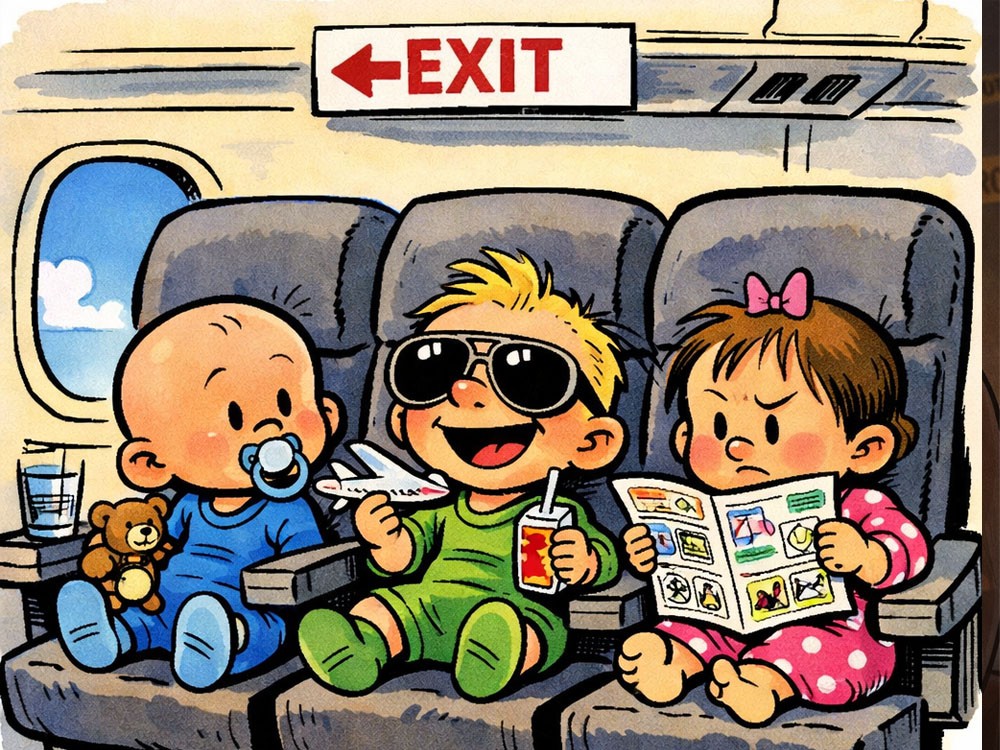
Three babies. Exit row. No adult supervision in sight—unless you count vibes.
This image is doing a lot of heavy lifting before a single caption is written. You’ve got the implicit rules of air travel colliding with the absolute unpredictability of infants. It’s a safety briefing meets a meltdown waiting to happen.
Naturally, many of you leaned into chaos. Crying, flying, and the quiet terror of being trapped at 30,000 feet with people who have no concept of “inside voices.” Strong instincts. Let’s taxi through what worked—and what could’ve used a smoother landing.
What We Saw a Lot
Crying jokes dominated the cabin. Variations on meltdowns, noise, and emotional instability showed up across multiple entries—“The mile-cry club,” “Aisle be crying the whole way home,” and “You are now cleared for meltdown” all circle the same comedic runway.
Airplane terminology was another frequent approach. Boarding groups, safety instructions, and pilot language gave writers a ready-made structure. “Boarding group: emotionally unregulated.” and “Please secure your own goldfish before helping others” both plug directly into familiar phrasing, which helps the joke land quickly.
We also saw a handful of “babies as adults” or “babies in charge” ideas—implying they’re pilots, authority figures, or just part of the standard passenger mix. That contrast is fertile ground, but it requires a precise twist to really pay off.
Missed Opportunities
A lot of captions identified the obvious tension (babies + plane = chaos), but stopped just short of sharpening it. The strongest jokes didn’t just acknowledge the crying—they reframed it through a specific lens or structure.
There was also room to push the exit row detail further. That’s the hidden comedic engine here. Exit rows come with responsibility, instructions, and expectations—none of which babies can meet. Only a few captions really exploited that contradiction directly.
Finally, some captions gestured at broader ideas (like politics or general annoyance) that drifted away from the image itself. In a visual prompt this strong, specificity almost always beats commentary.
Head to Head
POV: You are seated in the “character building” section of the plane
vs.
Boarding group: emotionally unregulated.
Both captions reframe the seating experience through a humorous label. But the finalist pulls ahead for a couple of reasons.
“Character building” introduces a subtle, relatable idea—this isn’t just inconvenient, it’s a test. It also uses POV framing, which immediately places the reader in the situation. You’re not observing the babies; you’re stuck with them.
“Boarding group: emotionally unregulated.” is clean and clever, but it stays at arm’s length. It labels the group without escalating the experience. The finalist adds a layer of personal consequence, which makes the joke feel fuller.
Red Lines
Back when I was younger I could babble on for days
This leans on a pun (“babble” / “babies”) but doesn’t quite anchor itself in the scene. The voice feels detached from the airplane context, so the joke reads more like a general wordplay exercise than a reaction to this moment. Strong captions usually make the setting unavoidable.
Hey i am the pilot of this plane
The idea—babies in positions of authority—is solid, but this version states it too directly. There’s no twist or framing beyond the premise. A stronger approach would add specificity or escalation (e.g., what kind of pilot behavior would a baby exhibit?). The gap between idea and execution here is about adding texture.
We’re going away from trump and his arrogance
This shifts entirely out of the image and into external commentary. The problem isn’t the topic—it’s the disconnect. The funniest captions in this contest stayed grounded in the absurdity already present. When the joke requires outside context, it has to work harder to justify the jump.
Winning Captions & Why They Worked
POV: You are seated in the “character building” section of the plane
This works by reframing discomfort as growth. It’s concise, relatable, and just abstract enough to feel clever without losing clarity. The POV angle pulls the reader in, and “character building” implies prolonged suffering in a way that feels earned.
Please secure your own goldfish before helping others
A standout for specificity. It mirrors standard airline instructions but swaps in a perfectly baby-coded detail. “Goldfish” does a lot of work here—it’s visual, age-appropriate, and unexpected enough to create a clean laugh.
The mile-cry club
Simple, direct, and effective. It riffs on a well-known phrase, but the substitution is tight and immediately readable. No extra setup needed.
Aisle be crying the whole way home
A classic pun with strong structural alignment to the setting. “Aisle” pulls the airplane context directly into the wordplay, which helps it feel grounded rather than generic.
You are now cleared for meltdown
This one benefits from authoritative phrasing. It mimics air traffic control language, which contrasts nicely with the emotional chaos implied by “meltdown.” The juxtaposition is clean and efficient.
Final Thoughts
This was a high-floor contest. The image gave everyone a strong starting point, and most captions found a solid comedic lane—crying, flying, or reframing airline language.
The next step is differentiation. When multiple people land on the same idea, the winners are the ones who add a specific twist, a sharper perspective, or a more immersive frame.
Think of it like seat selection: everyone’s on the same plane, but a little extra legroom—clarity, specificity, point of view—makes all the difference. ✈️
Now buckle up and head to the next contest—your best caption might just be cleared for takeoff.