Tips for Caption Contest 130
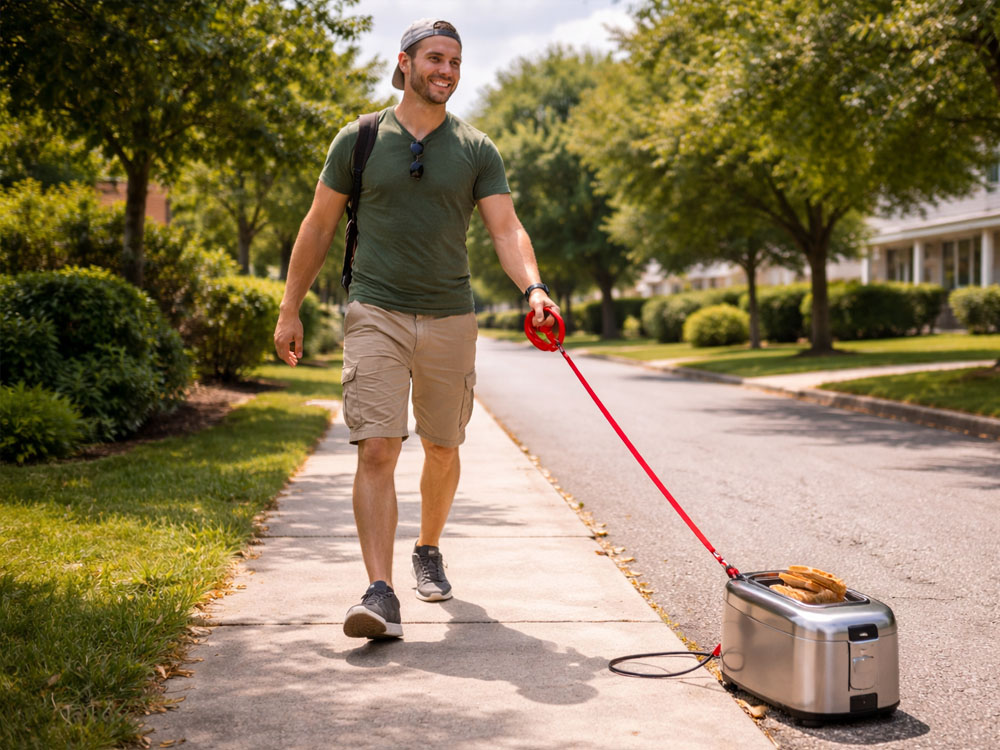
Every neighborhood has that guy. The one who zigged when everyone else zagged. The one who looked at a perfectly normal toaster and thought, “You need fresh air.”
And not just a casual stroll. This is a full commitment walk. Leash. Sidewalk. Suburban backdrop. The toaster isn’t being moved—it’s being exercised.
It’s the kind of image that feels one step away from making sense… which is exactly why it’s funny.
Because somewhere in this man’s mind, this is completely normal. 🧠
Getting Started: What’s in the Image?
Let’s inventory the scene:
- A man walking down a suburban street.
- He’s holding a leash.
- At the end of that leash: a toaster.
- Not being carried. Not in a bag. Walking, as if it’s a dog.
- Likely a quiet, residential setting—lawns, sidewalks, neighbors nearby.
Key details that matter:
- The confidence of the man. He’s not sneaking—he’s strolling.
- The domestication of the toaster. It’s being treated like a pet.
- The setting. Suburbs = rules, routines, normalcy.
- The leash. This isn’t random—it implies ownership, control, relationship.
The joke engine here is simple: everything about the setup says “dog,” except the one thing that isn’t.
Think Beneath the Surface
The obvious joke is “toaster = dog.” That’s your starting point, not your finish line.
Push deeper:
- Pet culture parody: What if this toaster has behaviors, needs, or personality?
- Owner psychology: Why is this man doing this? Lonely? Practical? Delusional? Ahead of his time?
- Suburban norms: This is a place obsessed with appearances. What happens when something quietly absurd breaks the pattern?
- Appliance logic: What does a toaster want? What’s its “natural behavior”?
There’s also a strong angle in treating this as completely serious:
- The man might be following rules (HOA-approved pets only).
- The toaster might be in training.
- This could be a workaround, a loophole, or a lifestyle choice.
Or go the other direction:
- The toaster is the one in control.
- The man is the weird one for not being a toaster.
The richest captions usually commit hard to a specific reality. Don’t hover between “this is weird” and “this is normal.” Pick one and go all in.
General Tips on How to Be Funny
1. Commit to the bit
Once you decide what world this image lives in, stick to it. Half-jokes feel uncertain. Strong captions feel inevitable.
- Example: “The vet said he just needs more outlets.”
2. Treat the absurd as ordinary (or vice versa)
Comedy thrives on contrast. Either normalize the toaster or make the situation even stranger.
- Example: “We switched to a lower-carb pet.”
3. Be specific, not generic
“Toaster dog” is broad. “Apartment-approved pet under 10 pounds” is specific—and funnier. Look for rules, labels, or systems you can plug this into.
4. Avoid describing the image
We can already see the toaster. Don’t say what it is—tell us what it means. The caption should add a layer, not a label.
5. Use misdirection efficiently
Set up one expectation, then flip it fast. The shorter the path to the twist, the stronger the punch.
- Example: “He only bites during breakfast.”
6. Explore relationship dynamics
This isn’t just a man and a toaster—it’s an owner and a “pet.” That opens doors: training, behavior, embarrassment, pride, routines.
7. Cut anything extra
If a word isn’t pulling weight, remove it. Tight captions hit harder. Read it once, then trim.
8. Think like a system
Put the toaster into real-world structures: dog parks, vets, HOA rules, dating profiles, insurance policies. Systems make absurdity feel grounded—and funnier.
Final Thought
This image works because it’s one small, confident step away from reality—and your job is to decide exactly how far that step goes. The sharper your point of view, the stronger the laugh.
Enter the contest and show us what kind of life this toaster is really living.