Tips for Caption Contest 131
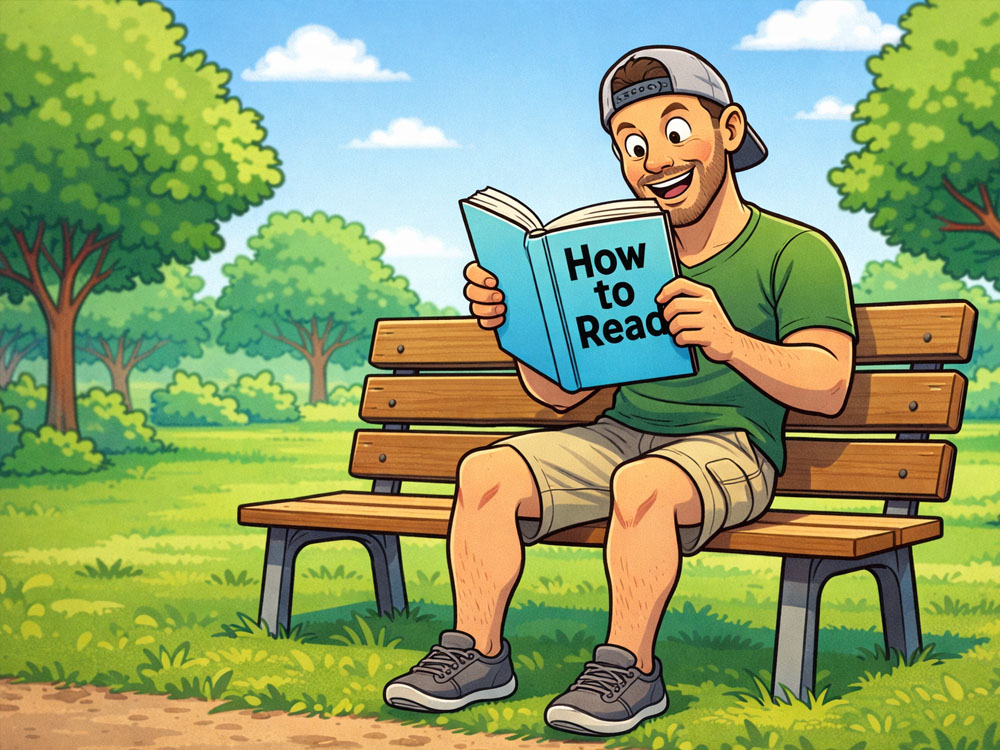
There’s confidence, and then there’s bringing a “How to Read” manual to the park like it’s light afternoon fiction.
This guy didn’t just pick up a book—he picked a starting point. No prequel, no warm-up, just straight to the fundamentals. It’s the intellectual equivalent of hiring a personal trainer to teach you how to walk.
And yet, he looks calm. Focused. Possibly thriving. Which raises an uncomfortable question: what if he knows something we don’t?
Because either this is the first step in a long journey… or the final boss of overthinking.
Getting Started: What’s in the Image?
Let’s inventory what matters:
- A man sitting on a park bench—neutral, everyday setting.
- He’s reading a physical book (already a choice in 2026).
- The book title is clearly visible: “How to Read.”
- His posture appears normal—no visible distress, just quiet concentration.
- The surrounding environment is calm, public, and unremarkable.
The joke engine here is simple but powerful: the content of the book conflicts with the basic assumption of the reader’s competence.
He’s doing something ordinary (reading), but the tool he’s using suggests he might not be qualified to do it.
That tension is the entire playground.
Think Beneath the Surface
This image isn’t just about literacy—it’s about levels of self-awareness.
Is he:
- A beginner taking his first step?
- Someone who forgot how to read and is starting over?
- An over-optimizer trying to “improve” a basic human skill?
- A philosopher questioning what reading even means?
You can also explore meta layers:
- Reading about reading while actively reading
- Learning how to do something you are already doing
- The idea that expertise requires revisiting fundamentals
Or shift into modern anxieties:
- Self-help culture taken too far
- Tutorials for everything (even obvious things)
- The fear of doing something “wrong” without a guide
Or go absurd:
- Step-by-step instructions for blinking, breathing, existing
- A world where basic skills require certification
The key is choosing one clear angle and committing to it. Don’t try to cover all interpretations—pick a lane and sharpen it.
General Tips on How to Be Funny
1. Lean into the contradiction
The humor comes from mismatch. Highlight it cleanly.
Example: “Finally moving on to chapter one.”
2. Avoid explaining the joke
We already see the title. Don’t restate it—build on it.
Example: “He skipped the audiobook to avoid spoilers.”
3. Pick a perspective early
Are you the man? An observer? The book itself? A teacher grading him?
Example: “Instructor says I’m not ready for subtitles yet.”
4. Keep the stakes oddly specific
Generic jokes flatten fast. Specificity creates texture.
Example: “Failed the pre-reading assessment.”
5. Escalate just one step past reality
Start grounded, then tilt. Not chaos—precision.
Example: “This is the advanced edition.”
6. Watch for over-cleverness
This image tempts philosophical spirals. Keep it tight. One idea, one turn.
7. Let confidence carry the joke
The funniest captions often sound certain, even when the premise is ridiculous.
Example: “Recommended by my doctor.”
Final Thought
Sometimes the funniest move is to take something embarrassingly basic and treat it with complete seriousness. That gap—between what it is and how it’s treated—is where the laugh lives.
Now go prove you already know how to read the room—submit your caption.