Tips for Caption Contest 158
Somewhere along the line, farm-to-table got… reversed.
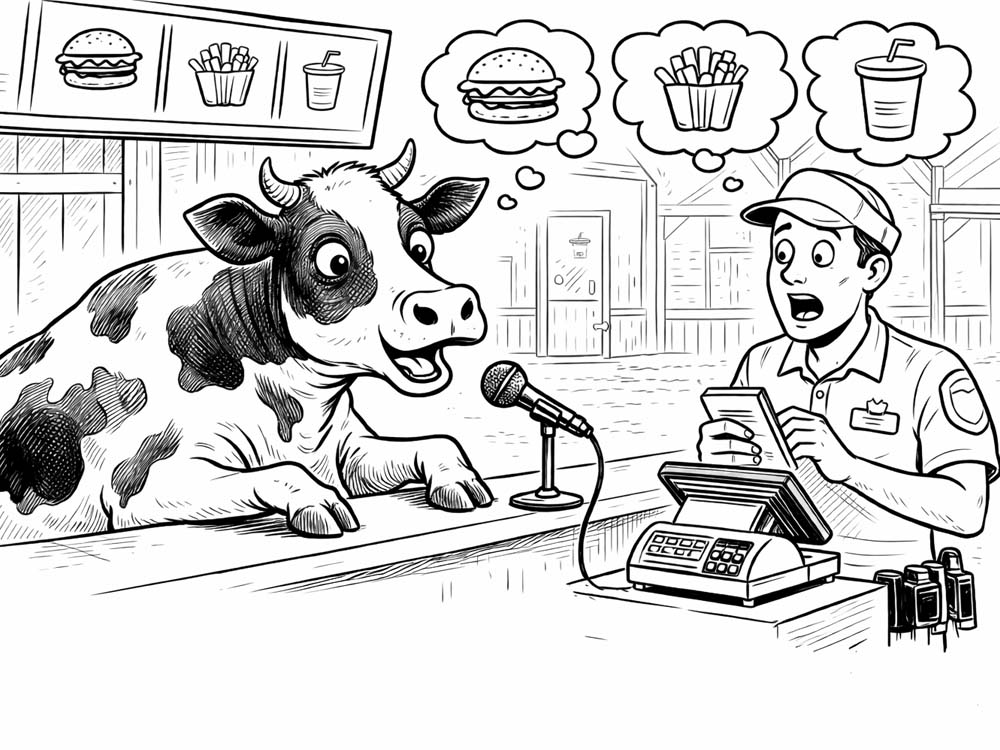
This cow didn’t just cross the road—it pulled up to the counter, cleared its throat, and is now placing a fully conscious order in the very system that commodifies it. That’s not just bold. That’s existentially confusing.
The cashier looks like they’ve just been handed a philosophical dilemma with a side of fries. And the cow? Calm. Focused. Possibly a regular.
This image works because it doesn’t just break reality—it does it politely, through a microphone. 🐄
Getting Started: What’s in the Image?
Let’s ground this before we spiral.
- A cow stands at a fast-food counter.
- The setting is a barn, not a traditional restaurant.
- The cow is using a microphone to place an order.
- A human cashier is visibly shocked, mid-transaction.
Details that matter for jokes:
- The microphone implies routine—this is a system the cow understands.
- The barn setting blends farm life with fast food culture.
- The cashier’s reaction gives you a strong “straight man” to play off.
- The cow’s composure is key—it’s not chaotic, it’s intentional.
The humor engine here is contrast: natural vs. industrial, prey vs. consumer, instinct vs. system.
Think Beneath the Surface
This image isn’t just absurd—it’s loaded.
First layer: role reversal. The cow isn’t food—it’s a customer. That flip alone gives you a lot to work with.
Second layer: awareness. If the cow understands ordering, does it understand the menu? And if it understands the menu… now you’re in darker territory.
Third layer: corporate normalcy. The presence of a microphone and a cashier suggests this isn’t a one-off. This might be policy. That opens the door to jokes about training manuals, loyalty programs, or confused onboarding procedures.
You can also explore tone shifts:
- Play it innocent (the cow doesn’t realize what’s happening).
- Play it savvy (the cow knows exactly what it’s doing).
- Play it systemic (this is just how things work now).
Unexpected angles tend to win here. Don’t stop at “cow ordering food.” Ask: what kind of customer is this cow?
General Tips on How to Be Funny
Pick one strong idea and commit.
Trying to cover the barn, the cow, the cashier, and the menu in one caption dilutes the punch. Choose your angle and stay focused.
Use the cow as a character, not just a prop.
Is it polite? Entitled? Nervous? Strategic? Personality adds clarity and makes the joke feel intentional.
Leverage the cashier as contrast.
A good caption often lives in the reaction. The more grounded the human, the funnier the situation becomes.
Keep the language tight.
The setup is already complex. Your caption should be clean and direct so the joke lands quickly.
Avoid obvious phrasing.
Anything that simply describes the situation without adding a twist will feel flat. Aim for a turn—something the reader didn’t immediately expect.
Use specificity to sharpen the joke.
Generic fast-food language is fine, but a precise detail (a type of order, a behavior, a policy) can elevate the humor.
Examples:
- Example: “I’d like to speak to whoever approved the menu.”
- Example: “Do you have anything that doesn’t feel personal?”
- Example: “I’m just here for the salads… for now.”
Notice how each one introduces a perspective rather than just restating the scene.
Final Thought
This image gives you a rare mix: visual absurdity with built-in commentary. If you can combine a clear point of view with a clean, unexpected turn, you’ll stand out fast.
Now go place your order—just maybe read the menu first.